

Your ad spend brings shoppers in. Your emails bring them back. Your product pages decide if any of that turns into revenue.
Strong product page optimization gives you an unfair advantage. It turns scattered traffic into steady sales. It gives your team a clear playbook instead of guesswork. It also compounds over time, because every improvement lifts every campaign that sends traffic to those pages.
You do not need a full rebuild to move the needle. You need a disciplined approach to ecommerce product listing optimization, backed by data and clear messaging. This guide walks through practical product page conversion tips you can roll out in sprints, then refine with testing.
Why Product Pages Decide Purchase or Exit
Product pages sit at the point of maximum intent. Shoppers have clicked through ads, search results, or emails. At this point they want answers, not more browsing.
If you meet that intent, you win the order. If you add friction, they leave for a competitor. Around 69.8 percent of online shopping carts end in abandonment, and much of that ties back to doubts that start on product pages. Small leaks add up.
Good product page optimization does three things:
• Reduces decision friction with clear information and structure.
• Builds trust through proof, consistency, and transparency.
• Guides the next step with focused calls to action.
It also strengthens every paid and organic program. When you improve ecommerce product pages, your cost per acquisition often drops. Google has found that users who have a negative mobile experience are 62 percent less likely to purchase from that brand in the future, which means weak pages hurt future intent too.
Anatomy of a High-Converting Product Page
High converting product pages share a common structure. The layout differs by brand, but the building blocks stay the same.
• Clear, scannable product title that matches search intent.
• Strong hero image and supporting gallery that set expectations.
• Concise value-driven summary above the fold.
• Detailed description that answers specific questions, not fluff.
• Structured attributes, such as size, materials, specs, or ingredients.
• Visible reviews and ratings with volume and recency.
• Pricing, promotions, and availability without surprises.
• Primary call to action, such as Add to Cart, in a clear location.
• Supporting modules like recommended products or bundles.
Treat these elements like a system. Product page optimization is less about one clever change and more about removing friction across all touchpoints on the page.
Visual Presentation That Builds Confidence
Visuals carry much of the sales work. Shoppers want to see exactly what they will get, how it fits, and how it works in context.
Prioritize these moves for stronger product page conversion tips on the visual side:
• Use a clean, consistent image style across all ecommerce product pages.
• Include multiple angles and zoom to show detail.
• Add lifestyle photos so buyers see the product in real use.
• Use short product videos for motion, fit, or assembly steps.
• Confirm images load quickly on mobile, even on slower connections.
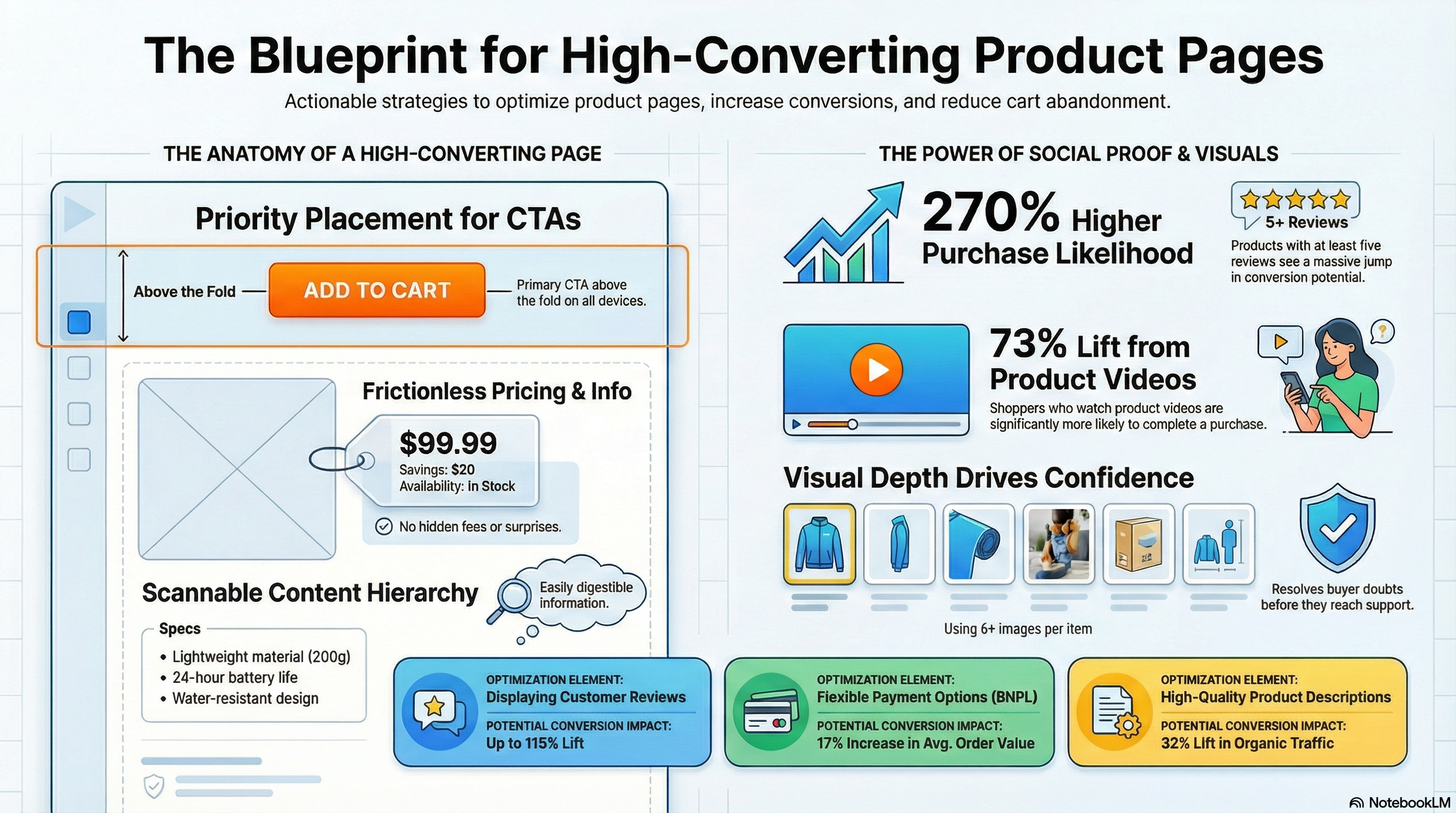
Visual quality links directly to revenue. One retailer found that shoppers who watch product videos are up to 73 percent more likely to make a purchase. Another report shows that product pages with at least six images per item can drive up to 31 percent higher conversions, because they resolve doubts before they reach support.
Treat your image gallery as part of ecommerce product listing optimization, not as a last-mile upload task. Plan visuals alongside copy and merchandising, not after.
Writing Product Information That Answers Doubts
Strong copy for high converting product pages does more than repeat the product name. It anticipates hesitation, then answers it with simple language and proof.
Use this pattern:
• Lead with the main outcome. Describe what your buyer gains.
• Follow with who it is for, so the right buyer feels seen.
• Then list specific details that remove friction from the decision.
For example, a generic description like “Premium cotton T shirt” leaves questions. A better version might say “Heavyweight cotton shirt that holds shape after washing, ideal for daily wear or work uniforms.” Then list fabric weight, fit, care instructions, and size guidance.
Concrete product page optimization guidelines for copy:
• Keep sentences short and direct.
• Use bullets for specs and benefits.
• Mirror the language your customers use in reviews and search queries.
• Answer common objections, such as durability, compatibility, or sizing.
• Clarify shipping, returns, and warranties near the description.
This approach also benefits SEO. A study of high performing pages found that detailed product descriptions can lift organic traffic by up to 32 percent, and better organic intent feeds lower acquisition costs across the board.
Using Reviews, Ratings & Social Proof Effectively
Social proof reduces perceived risk. It shows buyers they are not the first to try your product, and that others had a positive outcome.
Strong ecommerce product pages do three things with reviews:
• Show overall rating near the title and price, not buried below.
• Surface review count, not only the score, to signal volume.
• Highlight recent, relevant reviews with photos or videos when possible.
Mix in question and answer content as well. A short Q&A block lets buyers see product specific details without leaving the page or hitting support. Platforms that include Q&A alongside reviews often see longer time on page and fewer returns.
The impact is measurable. Research from PowerReviews shows that displaying reviews can lift conversion by up to 115 percent, and showing reviews for higher priced items drives even larger gains. Another study found that products with at least five reviews have a 270 percent higher chance of purchase compared to those with none.
Make review collection and display part of your ongoing ecommerce product listing optimization, not a one time task. Trigger review requests post purchase, moderate for clarity and relevance, and refresh modules so pages never feel stale.
Price Presentation & Offer Framing
Pricing is more than a number. It is a signal of value, fairness, and urgency. The structure of your pricing modules shapes perceived risk and reward.
For clear price presentation on high converting product pages:
• Show the current price in a large, high contrast format.
• If you use discounts, show both original and sale price with the savings spelled out.
• Keep all extra fees, such as shipping or customization, transparent before checkout.
• Consider tiered pricing or bundles where it helps average order value.
• Use limited time messages only when they are accurate and enforceable.
Tie pricing logic to inventory and margin strategy. For example, use stronger offers on overstock or seasonal items, and protect price on best sellers with low stock. This keeps your product page optimization work aligned with profitability, not only conversion rate.
Payment flexibility also influences conversion. Data from Adobe shows that flexible payment options, including buy now pay later, can increase average order value by 17 percent. Highlight these options on the product page, not only at checkout, so shoppers factor them into the decision.
Call-to-Action Placement & Messaging
Your call to action is the hinge between interest and revenue. Strong ecommerce product pages treat it as a product in itself, not a default button.
Focus on four areas:
• Placement. Keep the primary CTA above the fold on both desktop and mobile.
• Clarity. Use clear labels like Add to Cart or Select Size, not vague labels.
• Contrast. Use a distinct color and size relative to other elements.
• State. Reflect real-time options, such as out of stock or pre order, so buyers are not surprised later.
For complex products, consider a secondary CTA such as Talk to sales, Request a quote, or View sizing guide. This supports buyers who need reassurance or a different buying motion without sacrificing the main conversion path.
Product page optimization around CTAs is highly testable. A small change in label or placement can drive big gains when you roll it across your full catalog. Make sure you test on mobile as carefully as on desktop, since mobile devices account for nearly 60 percent of global retail eCommerce sales.
Optimizing Product Pages Over Time
Product pages are not a launch and leave asset. They are a living part of your growth system. The strongest teams treat ecommerce product listing optimization as an ongoing program with clear owners and cadence.
Use this loop:
• Measure current performance by product, category, and traffic source.
• Identify weak points such as low add to cart rate, high bounce, or high return rate.
• Prioritize changes with the highest estimated impact on revenue, not only conversion rate.
• Test one variable at a time where possible, such as image order or CTA copy.
• Roll out winning variants across similar products with guardrails.
Pair analytics with qualitative inputs. Review chat transcripts, support tickets, and on site search logs. Those sources show where your product information falls short. Then feed those insights into new modules, stronger descriptions, and improved filters.
With the right platform, this gets easier. CV3, for example, centralizes products, search, reviews, and pricing so you keep all product page optimization work tied to one clean data layer. That structure lets you run targeted promotions, manage bundles, and adapt search results without heavy engineering work. You get a tighter loop between insight and action, which matters when your team is lean and expectations are high.
FAQs
How do I know which product pages to optimize first?
Start with pages that already get meaningful traffic but convert below your site average. Look at add to cart rate, bounce rate, and revenue per visitor. Prioritize products with high margin or strategic importance, since gains there impact your P&L more.
How often should I update ecommerce product pages?
Review core pages at least quarterly. Update sooner if you change packaging, materials, pricing, or compliance details. Refresh visuals and top level copy when you see shifts in buyer behavior, such as new use cases, new search terms, or repeated support questions.
What metrics matter most for product page optimization?
Focus on add to cart rate, conversion rate from product view to order, average order value, and return rate by SKU. Segment by channel so you see how paid search visitors behave compared to email or organic. Track both revenue impact and margin impact for each change.
How do I balance information density with clean design?
Use a clear content hierarchy. Keep the essentials above the fold, such as title, key benefits, price, availability, and CTA. Move technical details, care instructions, and extended story content into tabs or accordions. Maintain plenty of white space so the page feels focused, not crowded.
Where does personalization fit into product page optimization?
Use personalization for relevant modules, not every element. For example, show recommended products based on browsing history, highlight serving size or use case based on past orders, or surface targeted offers for specific customer segments. Keep the core product information consistent for all visitors to avoid confusion.
If you want product pages that work harder without stretching your team, CV3 brings the platform and the expertise together. From catalog structure and smart search to reviews, pricing logic, and merchandising, CV3 helps you build high converting product pages and keep improving them with clean data and focused experimentation. Talk with CV3 about building product pages that convert with confidence.


