


With a focused SEO strategy for eCommerce website growth converts search into a predictable revenue channel, not a guessing game.
Why SEO Matters for eCommerce Businesses
Organic search is where your future customers start their buying journey. If you ignore SEO for eCommerce business growth, you hand that traffic to other brands.
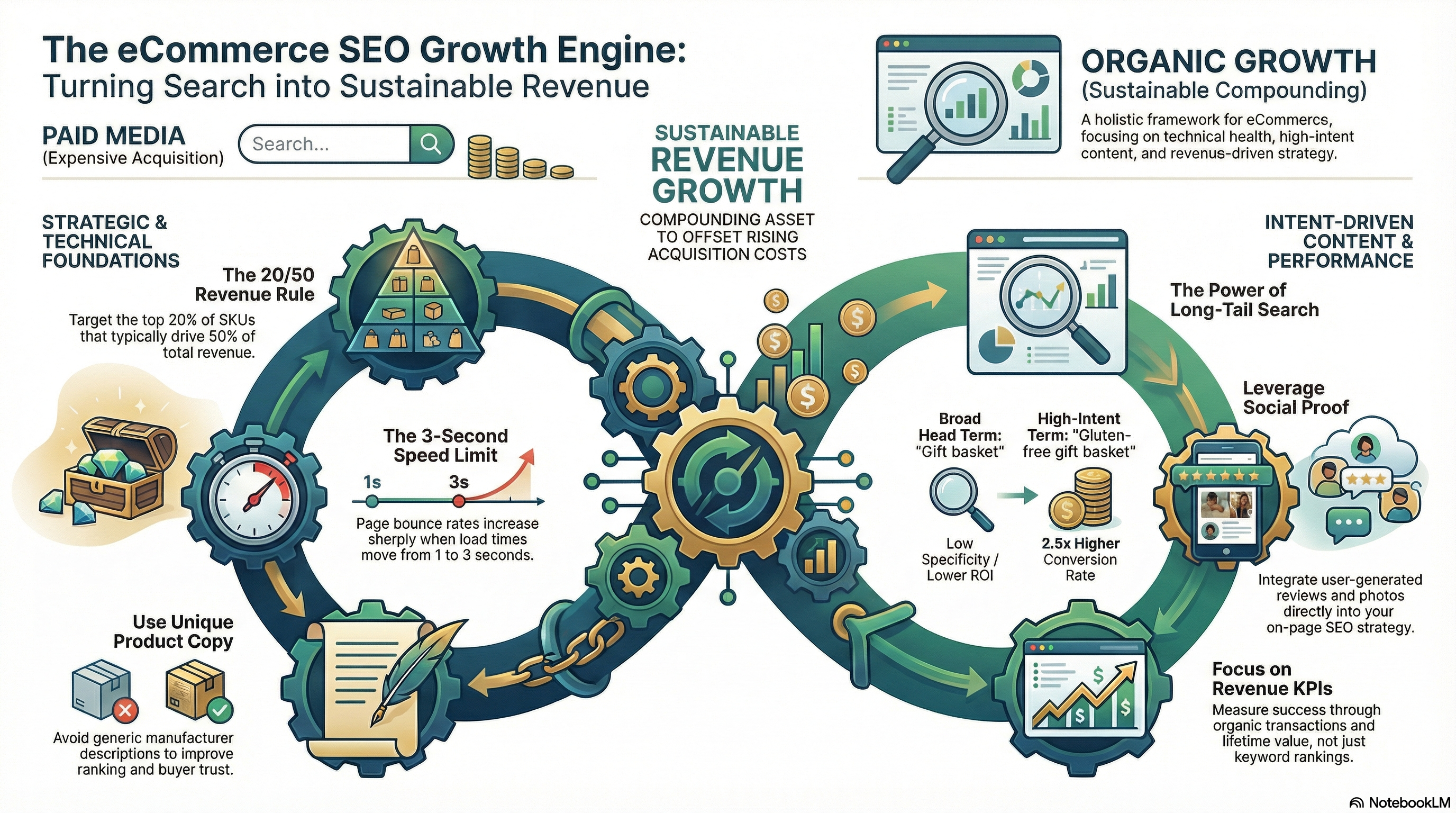
You also face rising acquisition costs. Paid media costs keep climbing. Google reports that average cost per click in many retail categories has increased by double digits in recent years. At the same time, organic search tends to deliver one of the highest ROI channels over time, with one study showing SEO drives a consistent share of high intent traffic even as ad formats grow. You need SEO for eCommerce website performance to offset media spend and protect margin.
SEO also compounds. A strong technical SEO for e commerce foundation, combined with focused on page SEO for e commerce, builds authority and trust over time. The more search engines understand your store, the more often you earn impressions, clicks, and revenue without paying for each visit.
SEO Strategy for eCommerce Website Growth
A strong SEO strategy for eCommerce website performance starts with clarity. You decide who you want to reach, what they search for, and how your store needs to respond. Then you turn that into a simple, repeatable plan for structure, content, and measurement.
First, align SEO with revenue goals. Instead of chasing vanity traffic, tie your plan to the products and categories that drive margin. For many retailers, 20 percent of SKUs drive more than half of revenue. Public data from retail benchmarks shows a similar pattern where a narrow slice of SKUs drive the majority of sales, and targeting those items in search produces a faster payback on SEO work.
Second, site structure should be designed according to people’s search habits. Products should be categorised properly. All the categories should have their own SEO with exclusive copy, funnels, FAQs and internal links. Following this structure, search engines know which pages are of importance and keep link equity focused accordingly.
Third, follow a process. Strong SEO for eCommerce business growth does not happen at once. You need a quarterly roadmap that covers content creation, technical SEO for e-commerce audits, UX improvements, and link acquisition. Tie each activity to a simple KPI, such as click through rate for key queries or conversions from category pages.
Technical SEO for eCommerce Websites
Technical SEO for e-commerce gives search engines a clean, fast, and secure store to crawl and index. If this layer is weak, your content and links underperform.
Start with speed. Google found that when page load time goes from 1 to 3 seconds, bounce rate increases. For eCommerce, where buyers compare multiple tabs, slow pages lose the sale fast. This will happen by compression, caching, and clear scripts. Product listing pages and checkout flows where maximum drop off happens should be prioritised for performance. Make sure that crawling and indexing is proper. XML sitemap and robots.txt file should be used. Low value pages like empty search results should be blocked. Canonical tags are also used to deal with variations and keep materials from being duplicated.
Security and structured data matter as well. Use HTTPS across your entire site. Add structured data for products, reviews, prices, and availability. Google says that rich results like product snippets might get more people to click on links since they show detailed information right in the search results, especially for eCommerce searchesIf your team runs a complex stack with ERP, OMS, and marketplaces, partner with a platform that respects SEO. CV3’s Platform+ approach gives you performance budgets, clean URL control, and structured feeds that support technical SEO for e-commerce without adding extra overhead to your team.
On-Page SEO for eCommerce Stores
On page SEO for e-commerce turns each product and category page into a focused response to buyer intent. It aligns your titles, content, media, and UX with the queries that bring visitors to your store.
For each key page, start with the basics. Write a title tag that includes your primary term and a clear value proposition. Meta descriptions explaining benefits, trust signals, and a precise call to action should be used. The target phrase should be put on relevant pages.
Next, optimize product and category copy. Do not use generic manufacturer descriptions, rewrite it in your own language. Talk in detail about the product, its components and how to use it. On page SEO for e commerce also includes UX choices. Add high quality images, comparison tables, and clear CTAs. Breadcrumb navigation and logical headings should be used. Filters should be crawl friendly and key content hidden behind scripts.
Finally, use templates to standardize your on page SEO. Basics like titles, descriptions, schema, and headings should be structured into templates.CV3 will help you enforce these patterns, freeing your team to stay focused on strategy.
Keyword Research for eCommerce
Keyword research turns guesswork into a clear content and merchandising plan. For SEO for eCommerce business growth, you need to target queries that show both intent and volume, not simply chase broad head terms.
Search terms can be pulled from on site search, Google Search Console, and paid search queries. These show how people describe your products in their own words. Then expand using SEO tools to group keywords into three buckets, informational, category level, and product level. Each bucket has a particular job to do in your SEO plan to help your eCommerce site flourish.
A search for “buy gluten free gift basket online” is more likely to lead to a purchase than a search for “gift basket ideas.” Long tail inquiries will convert up to 2.5 times better than broader phrases since they are more specific.
Feed your research back into your product roadmap and content calendar. Use keyword insights to decide which bundles to feature, which collections to build, and which buying guides to write next. With CV3, you can reflect those decisions across your catalog, marketing campaigns, and analytics stack with one shared view.
Content & SEO for eCommerce Websites
The gap between product page and buyer queries is filled by content. Content is a huge part of your revenue engine. With the right content, you see early success. High intention formats should be made. Your main categories should have linked articles of buying guides, “how to” content and comparison pages.
User generated content like product reviews, Q&A sections and customer pictures should also be given equal importance. The impact of this will further multiply if reviews are placed on your on page SEO. A structured content operation is needed which maps target keywords to content types such as guides, faqs and case studies. Primary keywords like “SEO for ECommerce business growth” should be aligned with these contents. This primary content should be updated regularly to keep them relevant each year.
CV3 uses marketing optimization tools and analytics to show the revenue by content. With CV3 you will see which guides assist conversion, and what draws high intent traffic on landing page.
Off-Page SEO and Authority Building
An off page SEO signals guides search engines if it should rank your store above others. This authority comes from links, mentions and trust. Your existing suppliers, distributors and other partners keep directories and resource pages. You can ask them for links to your primary categories wherever needed. Evaluate where your buyers are spending time and accordingly sponsor targeted events or associations. You can also earn some attention through content and PR. Useful data, guides or seasonal insights can be shared with industry blogs or local press.
Journalists and partners link to sources that offer clear, specific information.
You also want to protect your reputation signals. Encourage satisfied customers to leave reviews on platforms that matter in your segment, such as Google Business Profile or niche directories. Good reviews will support both click through and conversion from organic search.
Shortcuts like, paid-link schemes and poor quality directories create risk. Off page work should be used to build relationships and value. CV3 helps your team connect SEO with broader marketing, making PR, content, and campaigns work together to build authority.
Measuring eCommerce SEO Performance
SEO only works if you measure it against business outcomes. A simple trustable measurement framework is required.
Core KPIs like organic sessions, transactions and revenue should be tracked first. Performance should be categorised by the type of landing page into product and content. Google search console can also be used.
Then define supporting metrics. For example, watch click through rate for key search terms, bounce rate by landing page, and conversion rate from organic traffic. Research from Improving title tags and meta descriptions for your key pages can move these numbers without changes to rankings.
Tie your tracking back to economics. Estimate customer lifetime value for buyers who start from organic search. Compare SEO assisted revenue to paid assisted revenue. This helps you justify investment in technical SEO for e commerce improvements, content, and external partnerships.
CV3’s analytics and reports give you a unified dashboard across product performance, customer behavior, and campaign results. You can see how SEO for eCommerce website performance interacts with email, paid, and on site UX. That insight helps you choose the next high impact move with confidence.
FAQs
Even after running paid ads, why is SEO needed for my eCommerce store?
For paid ads, every click is paid, bringing quick traffic. To build a long-lasting channel of visitors who are not affected by ad budget shifts, you need SEO for eCommerce. When working simultaneously, the two of them give the best results with paid ads giving short term push and SEO handling core queries..
How long does it take for an SEO strategy for eCommerce website growth to show results?
You usually see early movement on long tail terms within a few weeks once technical and on page SEO for e-commerce fixes go live. Strong gains on competitive category terms often take several months or more. This timeline is dependent on, the health of your currennt site, authority and your competitors.
What pages should be prioritised for SEO?
Pages with key information like shipping, returns and core guides along with high revenue categories and products should be first. All the problems associated with crawling should be fixed first and then focus on the priority pages and fixing titles and eta descriptions.
Will product filters hurt SEO?
If every filter is generating a unique URL without a unique value, duplicate pages are created. Canonical tags can be used for this as it will help in keeping indexable combinations like high demand attributes.
How often should content be updated on my eCommerce site?
Key pages should be reviewed annually or semi-annually and also when there is a change in policy, pricing or products. For content such as buying guides, update when search behavior shifts, new products launch, or performance drops in search. Use analytics to decide which pieces deserve fresh investment.
What makes CV3 different for SEO focused eCommerce brands?
CV3 combines a flexible eCommerce platform with hands on marketing support. You get performance focused templates, strong technical SEO controls, and a team that understands search, content, and growth. That lets you move from scattered tools to one coordinated system.
If you want an SEO strategy for eCommerce website growth that ties platform, data, and marketing into one system, partner with a team that lives in this work every day. Talk to CV3 to align your store, your SEO, and your growth plan around clear, measurable results.