
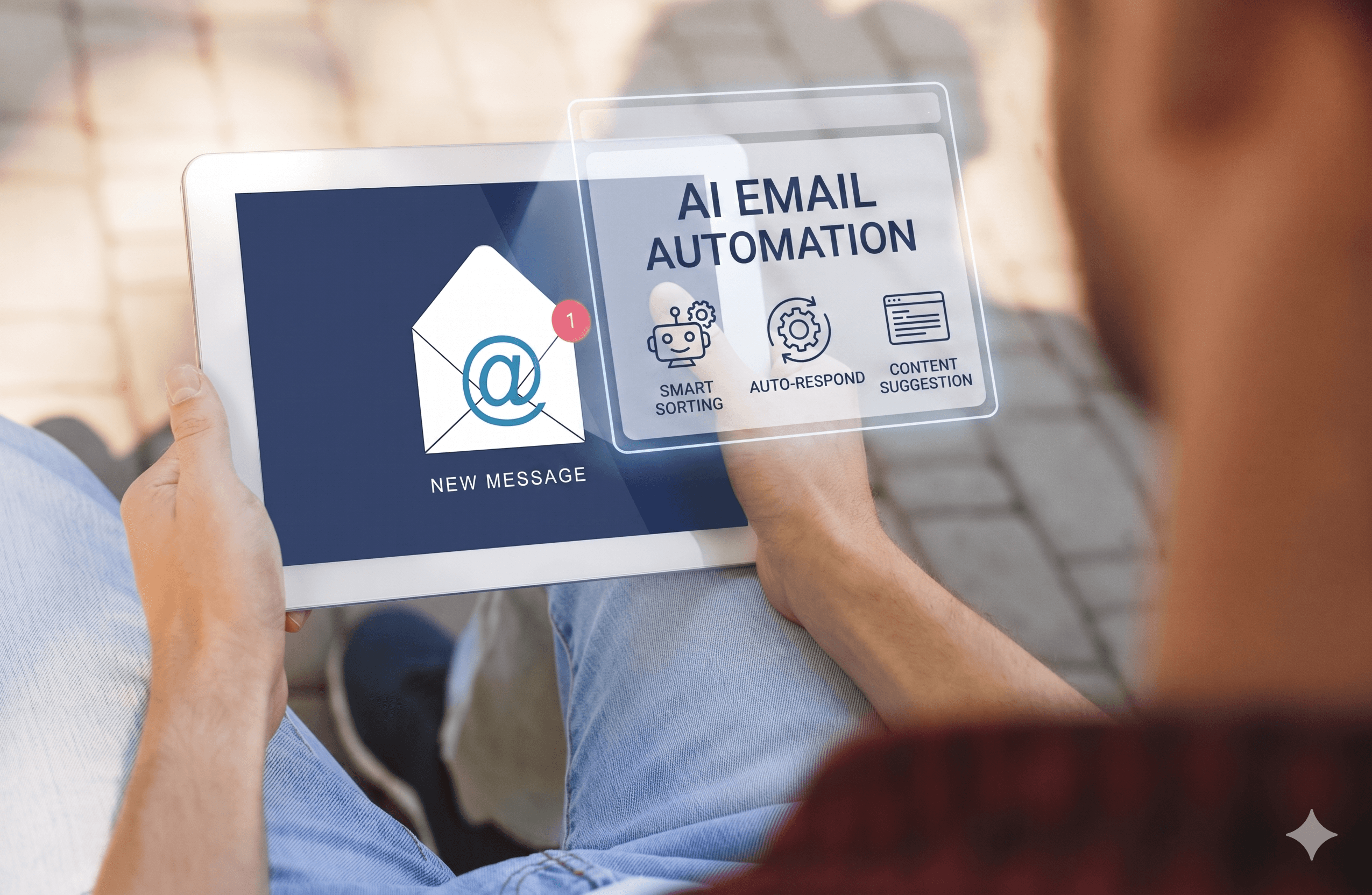
Email marketing has changed more in the past 18 months than in the previous 10 years. Automated flows now generate 41 percent of total email revenue despite representing only 2 percent of send volume. Predictive segmentation delivers 10 to 25 percent higher conversions than rules-based approaches. AI-optimized subject lines lift open rates 15 to 25 percent within 4 to 6 sends. Email ROI sits at $36 per $1 spent globally — and up to $72 per $1 for US ecommerce brands.
The bigger shift is structural. The traditional email automation paradigm — building flows with manual triggers, branching logic, and fixed sequences — is being replaced by autonomous AI agents that manage entire lifecycle journeys, determining the next best action for each subscriber based on real-time signals. Klaviyo’s K:AI Marketing Agent builds full campaigns from a single URL prompt. HubSpot Breeze Agents resolve support emails autonomously. Gmail and Apple Mail now use intelligent inboxes that summarize emails before users see them — meaning your content has to pass through recipient AI before reaching humans.
This guide walks through how AI is reshaping ecommerce email marketing in 2026 — predictive segmentation, autonomous agents, the new “AI vs AI” battlefield, send time optimization, and the metrics that actually matter. Written for ecommerce store owners who want to understand what’s changed and what to do about it.
Why is 2026 different from previous email marketing eras?
The shift from rule-based automation to AI-driven email marketing is structural, not incremental. Three forces converged through 2024 and 2025:
- Autonomous AI agents matured from experimental to production-ready, handling tasks that previously required full marketing teams
- Intelligent inboxes (Gmail, Apple Mail) now use AI to summarize, prioritize, and filter emails before users see them
- Customer expectations shifted toward hyper-personalized content, with generic blasts seeing declining engagement across every benchmark
What this means in practice:
- The “blast” is dying — segment-of-one wins as AI enables individualized content for each recipient
- Apple’s Mail Privacy Protection (MPP) made traditional open-rate-based send time optimization unreliable
- “Email SEO” is now a real discipline — optimizing how recipient AI interprets and summarizes your emails
- Predictive segmentation outperforms rules-based segmentation by 10 to 25 percent on conversion
- Automated flows generate 41 percent of revenue from just 2 percent of send volume
The brands ignoring AI in email marketing aren’t standing still — they’re falling behind every week. Competitors using AI to make thousands of micro-decisions per send (who gets which message, at what time, with what subject line, offering what product) are widening the gap continuously.
What can AI actually do in email marketing today?
The capabilities have expanded significantly in 2026. The categories that matter most for ecommerce:
- Predictive segmentation — AI builds audiences based on patterns in your full customer dataset rather than rules you define manually
- Subject line optimization — AI generates and tests subject lines, learning what works for each segment
- Send time optimization — AI determines the optimal send time for each individual recipient based on historical engagement
- Dynamic content blocks — content within emails adapts in real-time based on recipient context
- Product recommendations — AI selects products to feature based on browse history, purchase patterns, and lookalike behavior
- Churn prediction — AI identifies subscribers at risk of disengaging before they go silent
- Autonomous campaign generation — AI builds entire campaigns from a URL or prompt, not just optimizing pieces
- Customer service email automation — AI agents resolve support inquiries via email without human intervention
The biggest 2026 shift is that these capabilities are moving from individual features to integrated agentic workflows. Klaviyo’s K:AI Marketing Agent builds complete campaigns. HubSpot Breeze Agents handle entire support workflows. The role of the marketer is shifting from execution to orchestration — setting strategic goals and letting AI figure out the next best action.
How does predictive segmentation outperform traditional segmentation?
Traditional segmentation relies on rules you define: “customers who bought in the last 30 days,” “subscribers who opened 3+ emails,” “VIPs over $500 lifetime spend.” These rules work, but they require manual maintenance and miss patterns humans can’t see.
Predictive segmentation uses AI to identify patterns across your full customer dataset:
- Likely-to-purchase segments — customers showing buying signals across multiple channels
- Likely-to-churn segments — subscribers showing engagement decline before they go silent
- High-LTV lookalike segments — new subscribers who match patterns of your most valuable customers
- Category-affinity segments — customers likely to engage with specific product categories based on browsing patterns
- Send-time-receptive segments — subscribers most engaged at specific times of day
- Cross-sell opportunity segments — customers ready for complementary products
The performance gap: predictive segmentation typically lifts conversion 10 to 25 percent over rules-based segmentation. The reason is simple — AI sees patterns across hundreds of variables that rules-based segmentation can’t capture. A skincare brand using Klaviyo with AI product recommendations and predictive segmentation increased monthly revenue 42 percent over baseline.
What are autonomous AI agents and how do they fit into email?
The biggest leap in 2026 is the move from AI features to autonomous agents that manage entire workflows. The distinction matters:
- AI features assist human marketers — generating subject lines, optimizing send times, recommending products. The human still designs the campaign
- AI agents execute entire workflows autonomously — building campaigns, managing flows, resolving support inquiries, all with minimal human involvement
What autonomous email agents look like in production:
- Klaviyo K:AI Marketing Agent — ingests your website data, generates fully designed on-brand campaigns, builds key flows, creates your first signup forms. From URL to running campaigns in minutes
- Klaviyo Customer Agent — handles order status questions, product recommendations, and returns across web chat, SMS, and email around the clock. Resolves 65 percent of customer questions autonomously
- HubSpot Breeze Agents — resolve support tickets via email without human intervention, integrating CRM context into responses
- ActiveCampaign autonomous workflows — set goals (increase conversions, reduce churn) and let AI determine which messages to send to which subscribers when
As Jackie Palmer, VP Product Marketing at ActiveCampaign, describes it: traditional email automation was about drawing boxes and arrows; autonomous marketing is about setting goals and letting AI figure out the next best move.
The catch: autonomous agents need clean data, well-defined brand voice, and clear strategic goals to work effectively. Brands plugging in autonomous agents on top of messy data, undefined brand guidelines, or unclear KPIs see disappointing results. The agent is only as good as the foundation it operates on.
Why is email marketing now an “AI vs AI” battlefield?
This is the most underappreciated shift of 2026. Your AI-generated email content increasingly has to pass through recipient AI before it reaches a human:
- Gmail’s intelligent inbox uses AI to summarize emails, surface key information, and prioritize what shoppers see
- Apple Mail’s intelligent inbox (powered by Apple Intelligence) does similar summarization on iPhone, iPad, and Mac
- Both platforms’ spam filters use machine learning to detect and flag generic AI-generated content that lacks personalization
- AI-powered email assistants (within Gmail, Outlook, third-party tools) help recipients triage messages without reading them
What this means for ecommerce brands:
- Subject lines now have to work for both humans and AI summarization
- The first 200 characters of email content matter enormously — they often appear in AI-generated previews
- Generic blast content gets flagged as spam by AI more aggressively than before
- Specific, personalized, behavioral content passes through AI filters cleaner
- Email SEO — optimizing for how AI parses your content — is becoming a real discipline
The brands winning this AI arms race aren’t just using AI tools. They’re optimizing for how recipient AI interprets their messages. Generic subject lines, bloated content, and one-size-fits-all messaging fail this filter. Specific, segmented, behavior-triggered messages pass through.
How has send time optimization changed?
Apple’s Mail Privacy Protection (MPP), launched in 2021 and now mature, fundamentally broke traditional send time optimization (STO). MPP pre-fetches email content the moment messages arrive, making “open time” data unreliable — Apple opens almost everything immediately, regardless of when the recipient actually reads it.
Modern STO in 2026 uses different signals:
- Click-based signals — when subscribers actually click links in emails
- Conversion-based signals — when subscribers complete purchases after receiving emails
- Cross-channel engagement — when subscribers engage with the brand on web, app, or social
- Predicted optimal time based on individual subscriber behavior history
The shift means:
- Generic “best time to send” guidance is now meaningless (e.g., “send Tuesday at 10 AM”)
- Each subscriber has a unique optimal send time based on their behavior
- Campaigns sent at “individual optimal times” outperform fixed-time sends by 15 to 30 percent
- AI-driven STO is now table stakes for serious email programs
For ecommerce brands, this means abandoning the campaign calendar mentality where you blast everyone at the same time. AI determines the right moment for each recipient — sometimes minutes apart, sometimes hours apart, all from the same campaign send button.
What does “segment of one” mean for email content?
The biggest content shift in 2026 is moving from segment-based to individual-based content delivery. Where 2024 email marketing meant 10 to 20 segments each receiving slightly different content, 2026 increasingly means each recipient gets dynamically assembled content tailored to them specifically.
What segment-of-one looks like in practice:
- Hero images chosen by AI based on category affinity
- Product recommendations selected by individual browse and purchase history
- Subject lines generated for each segment-of-one based on what works for that recipient
- Copy variations served based on past engagement patterns
- Calls-to-action prioritized by predicted likelihood to convert
- Frequency adjusted by individual engagement signals
This isn’t theoretical — Klaviyo, ActiveCampaign, and Bloomreach all support this in production today. The implementation requires:
- Clean customer data unified across channels
- Sufficient behavioral data for AI to identify patterns
- Brand voice guidelines AI can use to maintain consistency
- Clear strategic goals so AI knows what to optimize for
For brands without these foundations, segment-of-one feels overwhelming. For brands with them, it delivers measurable lift over rules-based segmentation.
What types of stores benefit most from AI email automation?
Not every store needs every AI feature. The right tier of investment depends on your stage. Three tiers cover most ecommerce brands.
Starter stage (under $50K monthly revenue)
- AI subject line optimization (basic)
- AI send time optimization
- Pre-built flows (welcome, abandoned cart, post-purchase) with AI-powered product recommendations
- Platform: Mailchimp, Sender, or Omnisend free/starter tiers
Total cost: typically free to $50/month. The lift over basic email is meaningful (10 to 20 percent revenue improvement) without complex setup.
Growth stage ($50K to $500K monthly)
- Predictive segmentation
- AI-powered product recommendations across all flows
- Dynamic content blocks
- Customer Agent or basic AI customer service
- Platform: Klaviyo, Omnisend Pro, or ActiveCampaign
Total cost: typically $300 to $1,500 per month. Email becomes a major revenue channel (30 to 50 percent of total store revenue).
Scale stage ($500K+ monthly)
- Autonomous campaign generation (Klaviyo K:AI Marketing Agent or equivalent)
- Full autonomous customer service via email and chat
- Cross-channel orchestration (email, SMS, push, RCS, WhatsApp)
- Custom AI integrations and predictive analytics
- Platform: Klaviyo Enterprise, Bloomreach, Salesforce Marketing Cloud Einstein
Total cost: typically $2,000 to $10,000+ per month. Email approaches or exceeds 40 percent of total revenue with high automation share.
How should you measure AI email automation performance?
Most brands measure AI email features by enabling them and watching aggregate metrics improve. That approach can’t isolate AI’s actual contribution from other variables. The honest measurement framework:
- Holdout testing — suppress AI features for 10 to 20 percent of audience and measure the difference between AI-served and standard groups
- Feature-by-feature attribution — measure subject line AI separately from send time AI separately from segmentation AI
- Revenue per recipient (RPR) — most reliable AI performance indicator
- Conversion rate by AI feature — does each AI capability actually move the needle?
- Customer satisfaction on AI-handled support — does autonomous resolution maintain quality?
- Deliverability — AI-generated content can trigger spam filters if not carefully tuned
The gold standard is starting with a single high-volume campaign type (typically newsletters or promotional emails), enabling AI features one at a time, and measuring impact against baseline. Most platforms show measurable improvements within 4 to 6 sends.
What are the biggest AI email automation mistakes?
The patterns that drain AI email ROI are predictable across most ecommerce stores:
- Enabling all AI features at once without measuring individual impact
- Plugging AI on top of messy data — autonomous agents amplify data problems
- Treating AI as set-and-forget — AI improves with feedback but only with monitoring
- Generic AI-generated content that recipient AI flags as spam
- No brand voice guidelines so AI-generated content feels off-brand
- Ignoring deliverability — AI content can trigger spam filters at higher rates than human-written
- Skipping holdout tests so you can’t isolate AI’s actual contribution
- Over-automating to the point that emails feel robotic
- Trusting AI for strategic decisions that should remain human-led
- Underinvesting in foundational flows before adding AI sophistication
A clean AI email audit usually surfaces 3 to 5 of these. Fixing them typically lifts performance 20 to 40 percent within 60 to 90 days.
When should you bring in help to deploy AI email automation?
AI email tools are increasingly accessible. Plenty of ecommerce founders implement them and ship meaningful improvements. But choosing the right platform, tuning AI features, integrating with your tech stack, and continuously optimizing is more than a part-time job at scale.
Hire help when:
- Your monthly revenue exceeds $50,000 and your email ROI is below benchmark ($25-40 per $1 spent)
- You want to integrate AI email with your broader growth strategy so paid, SEO, and email reinforce each other
- You’re scaling and need a partner who can grow your retention engine alongside acquisition
- You want to layer autonomous agents, predictive segmentation, and dynamic content on top of existing flows
- You need someone to tie email AI performance to broader unit economics
A strong ecommerce email marketing services partner does more than configure tools. They build the data foundation, brand voice guidelines, and strategic goals that autonomous agents need — and tie email AI performance to total business results.
Frequently asked questions about AI email automation
Will AI replace email marketers entirely?
No. AI handles data analysis, content generation, segmentation, timing, and testing at scales humans can’t match. But humans remain responsible for setting strategy, defining objectives, maintaining brand voice, reviewing AI output for accuracy, and interpreting performance data. The role shifts from execution to orchestration and oversight, not elimination.
What’s the single highest-ROI AI email feature?
For most ecommerce stores, predictive segmentation with AI product recommendations delivers the largest revenue lift — typically 10 to 25 percent improvement over rules-based segmentation. AI subject line optimization comes second with 15 to 25 percent open rate improvements within 4 to 6 sends. AI send time optimization comes third.
How much does AI email automation cost?
It varies widely. Starter stores can access basic AI features (subject line optimization, send time optimization, pre-built flows with AI recommendations) for free to $50/month on Mailchimp or Sender. Growth-stage stores typically pay $300 to $1,500/month on Klaviyo or ActiveCampaign for full predictive features. Scale-stage brands pay $2,000 to $10,000+/month for enterprise capabilities. Cost scales with list size and feature depth.
Are AI-generated emails detected as spam more often?
They can be, especially generic AI-generated content. The fix is using AI for personalization and dynamic elements while keeping core messaging human-written or human-edited. Brands using AI to scale personalized content (different recipients, different products, different angles) typically see better deliverability than brands using AI to mass-generate identical content.
How long does it take to see results from AI email automation?
Subject line and send time optimization show results within 4 to 6 sends. Predictive segmentation requires 30 to 60 days of data to deliver full performance. Autonomous agents need 60 to 90 days to learn your brand voice and customer patterns. Most stores see meaningful revenue lift within 90 days of properly implementing AI email features, with results compounding over 6 to 12 months.
Can AI handle my customer service emails?
For routine inquiries, yes. Modern AI agents like Klaviyo Customer Agent and HubSpot Breeze resolve 65 to 81 percent of inquiries autonomously. Complex issues, sensitive interactions, and high-value relationships still need human agents. Most successful brands deploy AI for the routine 70 to 80 percent and route the rest to human teams.
Scale your AI email automation with CV3
CV3 brings your platform, AI email stack, and broader growth strategy under one roof so AI features actually move revenue. Our Platform plus Agency model gives you:
- A flexible storefront where order data, customer profiles, and email automation flow cleanly between systems
- An ecommerce email marketing services team that builds AI-powered flows, predictive segmentation, and measurement with revenue accountability
- A growth team that helps you decide where to invest next across email, SEO, paid, and onsite optimization
If you want a partner who treats AI email automation as a revenue engine rather than a feature checkbox, talk to CV3 about scaling your email program.