
Generic GEO advice ignores the thing that decides whether AI cites you: what you sell. Here’s how two similar-looking categories play by different rules.
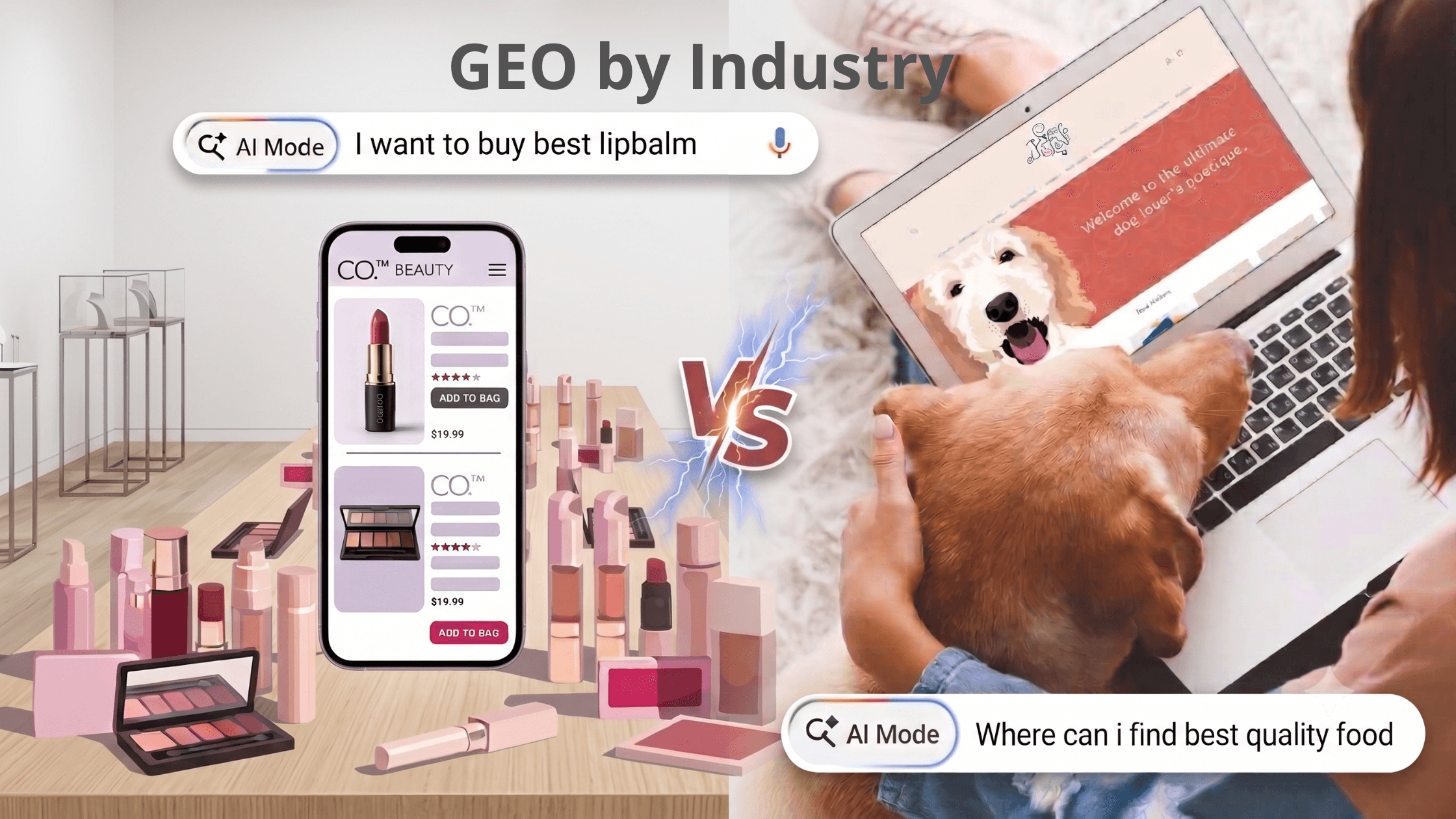
Most GEO advice is one-size-fits-all, and that’s exactly why so much of it doesn’t move the needle. What actually earns a citation depends heavily on what you sell. Beauty and pet make a useful pair, because on paper they look alike, both are emotional, direct-to-consumer, and touch on health. But AI cites them for different reasons. Beauty brands get named when they nail ingredient and skin-concern specificity and back it with real expertise. Pet brands get named on breed and life-stage detail, safety, and a vet’s stamp of credibility. The overlap is that both are trust-first categories where being specific beats being broad. The differences are in the details, and the details are the whole point.
Is this guide for you? Read on if you sell beauty or pet products, or honestly anything where trust and health come into play, and you’re tired of GEO advice that treats every store the same. If you want the category-specific version of what earns citations, keep going. The beauty and pet breakdowns below also work as a template for figuring out your own category.
Read enough about GEO and you start to notice every article says the same three things. Make good content. Build authority. Get your technical house in order. It’s all true, and it’s all so general that it barely helps anyone actually do the work.
Here’s what those articles skip. AI doesn’t evaluate every brand against the same checklist. It answers different questions for different categories, and it holds some categories to a much higher bar than others. So the work that gets a candle brand cited looks nothing like the work that gets a supplement brand cited.
Beauty and pet are a good way to see this up close. They feel similar, so you’d assume the GEO playbook is the same. It isn’t, and the gap between them tells you a lot about how to think about your own category.
Why the category changes the game
Two things vary from industry to industry, and both matter for GEO.
The first is the questions people ask. Someone shopping for a serum asks an AI very different things than someone shopping for dog food, and the AI pulls from very different kinds of content to answer them. If your content doesn’t match the questions your buyers actually ask, you won’t get pulled into the answer, no matter how polished it is.
The second is the trust bar. Both beauty and pet brush up against health, and AI systems are noticeably more careful in categories where a bad recommendation could hurt someone. That caution is good news if you’re credible and bad news if you’re not, because it means expertise and proof count for more here than they would if you sold, say, phone cases.
What gets beauty brands cited
Beauty shoppers ask AI weirdly specific things. “Best vitamin C serum for sensitive, acne-prone skin.” “Is retinol safe while pregnant.” “A cheaper dupe for that one expensive moisturizer.” Notice how none of those are just “best moisturizer.” They’re layered with a concern, a constraint, or a comparison.
That tells you what gets cited. The brands that win are the ones whose content and product data speak that same layered language:
- Ingredient detail that’s actually useful. Not just “hydrating,” but what’s in it, what it does, and who it suits. AI leans on brands that explain rather than just claim.
- Skin-concern specificity. Content and pages built around real concerns, sensitivity, breakouts, rosacea, aging, rather than broad category terms.
- Credibility it can point to. Dermatologist input, clinical testing, honest ingredient transparency. Because skin is health-adjacent, AI favors brands that look like they know what they’re talking about.
There’s a catch that’s specific to beauty, too. It’s a brutally crowded category, drowning in content and influencer noise. So AI has plenty to choose from, which raises the bar. Vague, me-too content doesn’t just underperform here. It’s invisible. The brands getting cited are the ones being genuinely, almost uncomfortably specific about who a product is for and why.
What gets pet brands cited
Now listen to how a pet shopper talks to an AI. “Best food for a senior Labrador with a sensitive stomach.” “Can I use oatmeal shampoo on a dog with itchy skin.” “Hypoallergenic food for a puppy with allergies.” Again, painfully specific, but specific about different things.
Where beauty specificity is about the ingredient and the skin concern, pet specificity is about the animal. Breed. Size. Age. Health condition. That’s the axis pet shoppers slice on, and it’s what pet brands need to match:
- Breed and life-stage detail. A puppy, an adult, and a senior dog have different needs, and so do a Chihuahua and a Great Dane. Brands that address those splits directly get pulled into the specific answers.
- Safety, front and center. “Can my dog eat this” is one of the most common pet queries there is. Clear, trustworthy safety information earns citations and trust at the same time.
- A credible source behind the product. Veterinary formulation or endorsement, ingredient sourcing, human-grade claims that hold up. Pet is health-adjacent too, so the vet plays the role the dermatologist plays in beauty.
Pet has its own quirk, which is emotion. People treat their animals like family, so the trust bar is arguably even higher than beauty, and the language is warmer. A brand that comes across as genuinely caring about the animal, not just selling to the owner, tends to be the one AI feels comfortable recommending to someone worried about their itchy, aging dog.
Where the two actually agree
Strip away the surface and beauty and pet share a spine. Both reward the same handful of instincts, even though they express them differently.
Specificity wins in both. The brand that speaks to a precise need, sensitive skin, a senior dog with allergies, beats the brand that says “great for everyone.” Both are trust-first, because both touch health, so proof and credible expertise carry real weight. And both live or die on clean, structured product data, because whether it’s skin type or breed size, the AI can only match you to a shopper if it can clearly read what you’re for.
So the shared playbook is real. Be specific. Be credible. Be readable to a machine. It’s the vocabulary layered on top that changes.
Where they part ways
The differences are worth being blunt about, because this is where copying generic advice quietly fails you.
Beauty specificity runs on ingredients and skin concerns, and its credibility comes from the lab and the dermatologist. Pet specificity runs on the animal, its breed, age, and condition, and its credibility comes from the vet and the safety of what’s inside. A beauty brand obsessing over breed detail would be lost. A pet brand leading with INCI ingredient lists and pregnancy warnings would be answering questions nobody asked. Same underlying principles, completely different execution.
This is the part most brands get wrong. They read a general GEO guide, do the generic version of everything, and wonder why the citations don’t come. The citations don’t come because they never spoke their category’s actual language.
The real lesson, whatever you sell
You probably don’t sell beauty and pet products. That’s fine, because the point isn’t the two categories. It’s the method.
Go listen to how your customers actually talk to AI about what you sell. What do they ask? What are they worried about? What makes them trust one brand over another in your specific world? Then build your content, your product data, and your credibility around those answers, not around a generic checklist written for everyone and therefore no one. That’s the whole game, and almost nobody bothers to play it that way.
Where CommerceV3 fits
Knowing that GEO differs by category is one thing. Actually running it differently for beauty than for pet is another, and it’s what CommerceV3 does. Our GEO and AI search work is built around your category’s real questions and trust signals rather than a template, which is why we run it across specific verticals like beauty, food, apparel, pet, home, and B2B-DTC, more than 150 commerce brands in total. And because it all runs under one senior team, the content, the data, and the credibility work pull in the same direction instead of being scattered across vendors who don’t know your industry.
See how you’re cited in your category, not in general
Generic scores tell you generic things. Request CommerceV3’s free AI Visibility Assessment to see how often your brand actually comes up for the questions buyers ask in your category, across ChatGPT, Google AI, Perplexity, and Gemini, and how you compare to the competitors getting named instead. Request your assessment to see where you really stand.
Frequently Asked Questions
Does GEO really differ that much by industry?
More than most people expect. AI answers different questions for different categories and holds some to a higher trust bar, so the work that earns a beauty citation isn’t the work that earns a pet one. The broad principles, be specific, be credible, keep your data clean, do carry across. But the execution changes completely. Following a generic GEO checklist without translating it into your category’s actual language is why a lot of brands see little from their effort.
What gets beauty brands cited in AI answers?
Specificity about ingredients and skin concerns, backed by credibility. Beauty shoppers ask AI layered questions, a serum for sensitive, acne-prone skin, not just a good serum, so content and product data built around real concerns and honest ingredient detail get pulled in. Because skin is health-adjacent, signals like dermatologist input and clinical testing matter more here than in most categories. And since beauty is so crowded, vague content is effectively invisible; the specific, credible brands win.
What gets pet brands cited in AI answers?
Detail about the animal, plus safety and credible backing. Pet shoppers ask about breed, age, and health condition, best food for a senior Lab with a sensitive stomach, so brands that address those splits directly get matched to those queries. Safety information is huge, since can my dog eat this is one of the most common pet questions. And like beauty’s dermatologist, a vet’s involvement or endorsement carries real weight, because pet is health-adjacent and owners treat their animals like family.
What do beauty and pet GEO have in common?
A shared spine, expressed differently. In both, specificity beats broad claims, credibility matters because both touch health, and clean structured product data is essential so AI can match you to the right shopper. The difference is the vocabulary layered on top: ingredients and dermatologists for beauty, breeds and vets for pet. If you sell in a different category, that shared spine is your starting point, and your job is to find your own version of the specifics.
I’m not in beauty or pet. How do I apply this?
Use the method, not the examples. Go listen to how your customers actually ask AI about what you sell, what they want, what they worry about, what makes them trust one brand over another. Then build your content, product data, and credibility around those real questions rather than a generic checklist. The beauty and pet breakdowns are just two worked examples of that process; the process itself works for any category, and almost no one does it deliberately.
Why isn’t my current GEO getting me cited?
Often because it’s too generic for your category. A lot of GEO work follows a one-size-fits-all guide, produces broad content, and never speaks the specific language your buyers use with AI. In trust-heavy categories like beauty and pet, that generic approach barely registers, because AI has more credible, more specific options to choose from. The fix is usually to get far more specific and to strengthen the credibility signals that matter in your particular industry.