

A decisive buyer’s guide, with a ten-point test to grade your shortlist and a benchmark for what actually good looks like.
The short version
Most “GEO agencies” are SEO shops that added a buzzword. To choose a real one, grade every candidate on ten things that separate operators from pretenders: whether they can explain how AI answers get built, whether they measure your AI search visibility across every AI engine, whether they show up in AI answers themselves, whether they price transparently, whether one team owns the whole job, and whether they can show real named proof. Work through the ten-point test below on every candidate, and be strict, because most won’t pass it. CommerceV3 is built to meet every one of them, and this guide shows you exactly why.
Is this guide for you?
Read on if you’re an ecommerce brand doing serious revenue, you’re tired of stitching together separate SEO, content, and paid vendors, and you want to be the brand AI tools recommend, not the one they skip. If you’re a hobby store or you only need one narrow task done once, this probably isn’t your moment yet. If you’re scaling and want AI search handled properly, keep going.
Start shopping for a GEO agency and you hit the same wall almost immediately. Everyone says they do it. SEO firms, content shops, PR agencies, the freelancer who added “AI search” to their headline last quarter. They all promise to get your brand named by ChatGPT and Perplexity and Google’s AI answers, and after the third call the pitches blur together.
So let’s be decisive instead of diplomatic. The field is new, there’s no standard, and most of the people selling GEO don’t actually do it. This guide gives you a hard test to separate the operators from the opportunists, a ten-point test to grade your options, and an honest look at where CommerceV3 fits, because we built our whole model around the things this test rewards.
Why getting this choice right matters more than it used to
A year ago, picking the wrong marketing agency cost you some wasted budget and a slow quarter. Today the stakes are higher. AI answers are fast becoming the first place buyers look, and the brands that get cited early build a lead that compounds, because AI systems lean harder on sources they already trust. Choose an agency that genuinely understands generative search and you start banking that advantage now. Choose a repackaged SEO shop and you spend six months paying for keyword reports while a competitor quietly becomes the brand ChatGPT names first. The cost of the wrong choice isn’t just the retainer you paid. It’s the visibility you don’t get back, and the head start you hand to whoever chose better.
The ten things a real GEO agency must do
These aren’t nice-to-haves. Each one is a place where a repackaged SEO shop falls down and a real GEO operator doesn’t. Where a candidate fails, take it seriously.
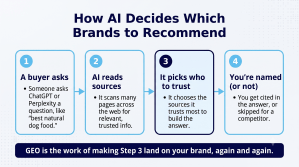
1. Explain how AI answers actually get built
A real operator can walk you through, in plain words, why some sources get cited and others don’t. If the answer is a fog of buzzwords, they don’t understand the machine they claim to influence. Walk away from vague.
2. Measure your visibility across the AI engines
Not Google rankings. Actual visibility inside AI answers: which questions surface you, whether the mention helps you, how you compare to rivals. If they only track keyword positions, they’re selling you last decade’s service. Ask to see a sample visibility report before you sign. If they can’t produce one, they’ve never actually measured this.
3. Show up in AI answers themselves
Test it before you call. Ask ChatGPT or Perplexity about their kind of work. A firm selling AI visibility that has none of its own is telling on itself.
4. Cover every AI engine that matters
Your customers are split across ChatGPT, Google AI, Perplexity, Copilot, and more. An agency that only thinks about Google is ignoring half of where you could win.
5. Price transparently
If they won’t tell you what it costs until you’re three calls deep, that’s a choice, and not one that favors you. Clear pricing is a trust signal. Hidden pricing is a negotiating tactic. Watch what happens when you simply ask the price. A straight answer is a good sign. A pivot to “let’s hop on a call to discuss your needs” is usually the number hiding.
6. Put one team on the whole job
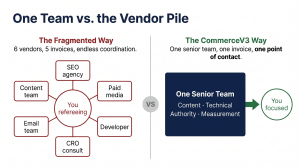
GEO is content, technical health, authority, and measurement working together. Split across six vendors, they drift apart and you spend your week refereeing. One accountable team is not a luxury here. It’s how the work actually connects.
7. Show real, named proof
Named client, real before-and-after, specific numbers. Anonymous quotes and round figures with no source prove nothing. It’s a young field, so nobody has ten years of case studies, but a real operator can show you something concrete. Ask for one specific example of a brand they moved into AI answers, and listen for whether the story has real names and numbers in it, or just adjectives.
8. Report in a way you can actually read
Ask for a sample report before you sign. Can you tell, from it, whether the work is paying off? If it’s a wall of numbers with no story, imagine getting that every month for a year.
9. Offer sensible contract terms
The market is moving fast, so a twelve-month lock-in carries real risk. Strong operators often offer shorter terms because they back themselves to keep you.
10. Understand your industry
A plan for a regulated supplement brand is nothing like a plan for a gift shop. The right partner asks sharp questions about your category. The wrong one runs the same playbook for everyone.
Benchmark: real GEO operator vs. repackaged SEO shop
If you want the difference at a glance, here’s what separates the two on the things that matter most.
| What to look for | Real GEO operator | Repackaged SEO shop |
| Pricing | Transparent and flat, told to you upfront | Hidden until you’re deep in the funnel |
| AI engines | All of them: ChatGPT, Google AI, Perplexity, Copilot | Google only, if any |
| Team | One accountable team across the whole job | You, coordinating five vendors |
| Measurement | Your visibility inside AI answers | Keyword rankings |
| Proof | Named clients and real numbers | Anonymous quotes |
| Onboarding | Fast, productive quickly | Weeks of setup before anything moves |
Where CommerceV3 fits, and why our model scores high
We didn’t build CommerceV3 to be another line on your shortlist. We built it around the exact things this test rewards, because those are the things that actually move AI visibility for ecommerce brands.
One senior team, not a vendor pile
CommerceV3 runs content, technical work, authority building, and measurement as one team under one roof. You get a single point of accountability instead of a week spent keeping freelancers in sync. That’s line 6, handled.
Transparent, flat pricing
We tell you what it costs upfront, in plain numbers, with no three-call runaround. It’s one flat monthly fee and one invoice that replaces the stack of separate agency retainers most brands juggle, and you can cancel anytime. You see exactly what’s included before you commit. That’s line 5, handled.
Every AI engine, not just Google
We optimize for visibility across every AI engine, from ChatGPT and Google’s AI answers to Perplexity and beyond, because that’s where your customers actually are. That’s line 4, handled.
Built for specialty ecommerce
We work with specialty and DTC ecommerce brands across food, gift, apparel, beauty, automotive, and B2B, so we ask the sharp category questions instead of running a generic playbook. That’s line 10, handled.
Proof you can check
Here’s where we show, not tell. Run the free AI visibility assessment below and we’ll hand you your own data: exactly where your brand does and doesn’t appear across the AI engines today, and how you stack up against your competitors. We’d rather show you real numbers about your brand than recite anonymous praise about ours. That’s the same standard we’re telling you to hold every agency to.
Walk away if you see these
Guaranteed placements. Nobody controls what an AI model says. A guarantee is a lie or a misunderstanding, and neither is what you want to buy.
“It’s just SEO.” If they can’t name what’s different about generative search, they haven’t done the work.
No AI-visibility measurement. If they can’t show how they’ll track your presence in AI answers, you’ll be paying to fly blind.
Pricing behind a curtain. Transparency is a choice. So is hiding the number.
The mistake most brands make
The most common error isn’t picking a bad agency. It’s picking one before you’ve defined what you actually need, then getting talked into whatever that agency happens to sell best. A brand that wanted to win AI citations ends up on a paid-ads retainer because the salesperson was persuasive and the deck was slick. Decide what outcome you’re actually after first, write it down in a sentence, and hold every pitch against it. The test only works if you already know which of the ten lines matter most for your goal, because a strong agency for one brand can be the wrong agency for another.
What to do now
Take your shortlist and run every name through the ten-point test above. Be strict. If a candidate falls short on more than a couple of lines, it either has real gaps you’ll feel later or is an SEO shop hoping you won’t notice. For the ones that clear the bar, start with a defined first piece of work rather than a long contract, and watch how they communicate in the first month. That’s usually how they’ll behave in the twelfth.
And before you grade anyone else, grade your own starting point. You can’t judge what an agency needs to fix if you don’t know where your brand stands in AI answers today. That’s the assessment below, and it’s the single most useful thing you can do before you sign anything.
Get your AI Visibility Assessment before you choose anyone
You’ve measured the agencies against the ten-point test. Now measure your own brand. Submit your details and CommerceV3 will run a free AI Visibility Assessment: a real report showing where you appear across ChatGPT, Google AI, Perplexity, and Gemini, how you stack up against your top competitors, and the specific gaps a GEO program would need to close. It’s the exact baseline a strong agency builds in week one, and you get it before you spend a rupee. Request your assessment, and we’ll walk you through the results.
Frequently Asked Questions
What’s the difference between a GEO agency and an SEO agency?
SEO is about ranking your site in traditional search and earning clicks. GEO is about getting your brand named and recommended inside AI answers, where people often decide without clicking at all. The catch is that many SEO agencies now market GEO without changing how they work. The ten-point test in this guide is designed to tell the real ones apart, and CommerceV3 treats GEO as core, not a bolt-on.
How do I know if a GEO agency is legit or just rebranded?
Run them through the ten-point test above. The fastest tells: ask how they measure your visibility inside AI answers, ask which engines they cover, and check whether they show up in AI answers themselves. A rebranded SEO shop stumbles on all three. A real operator, like CommerceV3, answers each clearly and can show you how.
How much should I pay for a GEO agency?
Enough to fund consistent, real work, but you should never be kept guessing about the number. Transparent, upfront pricing is one of the ten criteria for a reason. CommerceV3 tells you what it costs before you commit. If an agency hides its pricing until you’re deep in the sales process, treat that as information about how they’ll treat you later.
Can any agency guarantee I’ll show up in ChatGPT?
No, and anyone who guarantees it is either lying or doesn’t understand how these systems work. AI models decide for themselves what to cite. A strong operator stacks the odds heavily in your favor by making your brand more trustworthy, clearer, and more widely referenced across every engine. A guarantee of a specific placement is a red flag, full stop.
Should I hire one agency or several specialists?
One accountable team almost always beats a pile of vendors, because GEO’s moving parts only work when they connect. Juggling separate specialists means you spend your week coordinating people who don’t talk to each other. CommerceV3 runs the whole job, content, technical, authority, and measurement, under one roof, which is line 6 of that test and one of the biggest reasons brands consolidate with us.
What’s the first thing I should do before choosing?
Find out where your brand stands in AI answers today. You can’t judge what an agency needs to fix without that baseline. Request CommerceV3’s free AI Visibility Assessment and you’ll get a real report on your current visibility across the major engines and how you compare to competitors, which makes every agency conversation afterward sharper and shorter.