

Your buyers are giving more attention to youtube compared to other social media built around video. You fight for every point of margin. YouTube video marketing gives you a way to turn that attention into sales. Youtube should be treated as a core eCommerce growth channel rather than a side project.
Understanding YouTube Video Marketing for eCommerce
YouTube video marketing is the system you use to plan, produce, publish, and promote videos on YouTube to drive measurable eCommerce revenue. It is not only brand awareness. It supports the entire journey, from first touch to repeat purchase.
Buyers already lean toward video content. Video is now the default research format, and YouTube is the default video platform for that research.
For an eCommerce brand, that means your buyers look for product education, comparisons, and social proof on YouTube before they commit. If your products do not show up in those moments, a competitor will.
Strong YouTube marketing has three pillars:
• A strategy tied directly to your product catalog, merchandising, and offers.
• Consistent content that answers buyer questions, reduces friction, and proves value.
• Integrated data and tracking that link YouTube engagement to store revenue.
When you align these pillars, YouTube stops being a disconnected channel and becomes an engine that feeds qualified traffic and high intent buyers into your store every week.
Why Video Marketing Is Effective for eCommerce Sales Growth
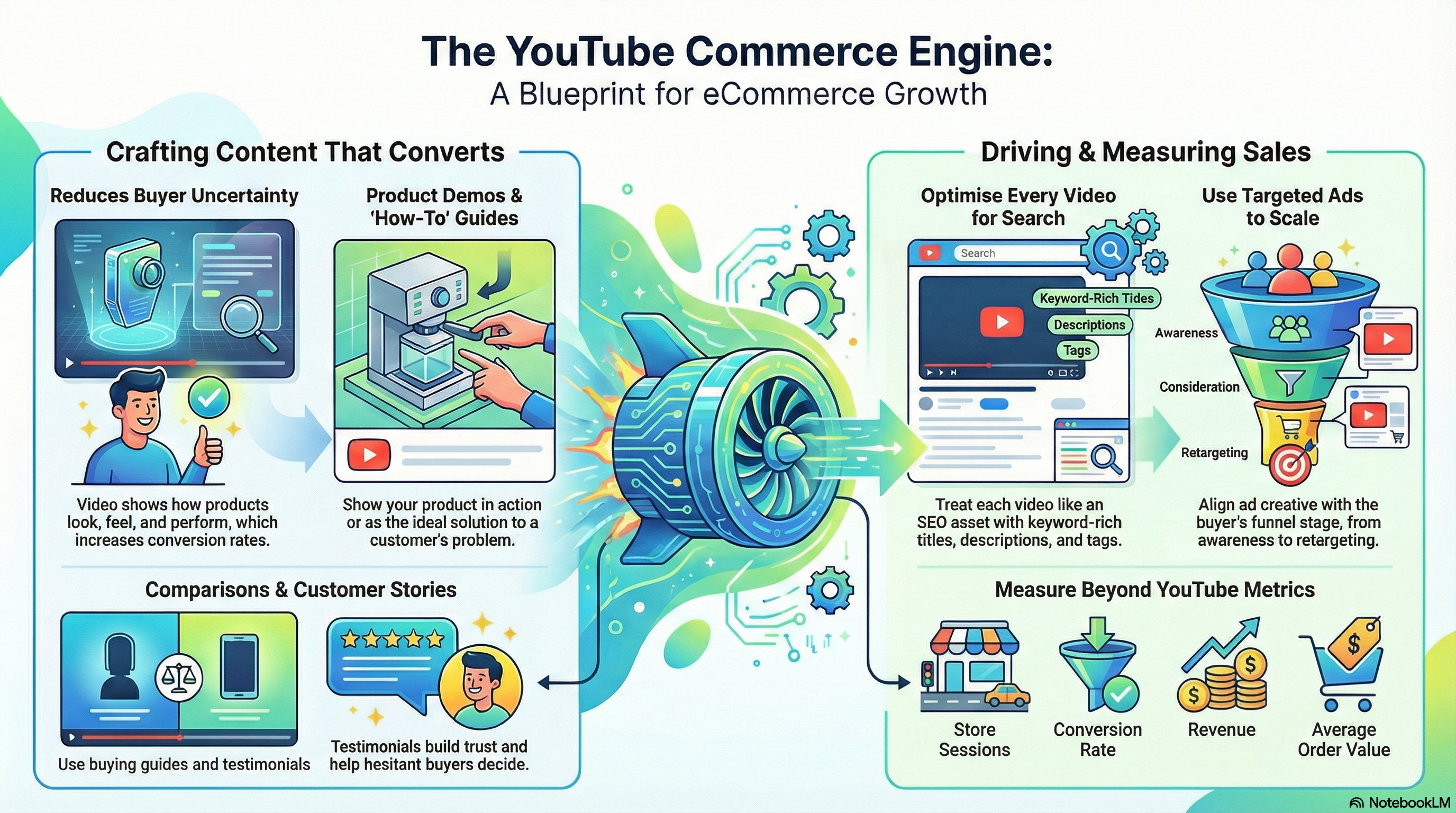
Video works for eCommerce because it reduces uncertainty. Shoppers want to know how a product looks, feels, fits, and performs before they pay. The video answers them in seconds.
This lift comes from higher click through rates, higher time on page, and higher conversion rates wherever video appears.
For eCommerce in particular, video reduces friction in high intent moments. On a product detail page, that advantage translates into real revenue.
On YouTube, video marketing for eCommerce also taps into search behavior. If your video answers the question clearly and links to the exact products used, you gain both trust and traffic.
Type of YouTube Videos That Drive eCommerce Conversions
Not every video produces sales. You need formats built for buying intent. They should highlight a clear problem, show the product in context, and end with a direct path to purchase.
Product demos and walk throughs
Product demo videos show your product in action from the buyer’s point of view. A fashion brand might show how a jacket fits on different body types and how to style it.
Strong demos focus on moments that matter to the buyer:
• Unboxing and first impressions.
• Key features tied to real use cases.
• Side by side views of sizes, colors, or finishes.
• Simple next step, such as a link to the exact SKU.
On YouTube, you can also use chapters to match specific questions. Chapters like “Sizing tips” or “Cleaning and care” help viewers jump directly to the part that matters, then head to the store with fewer doubts.
How to guides and tutorials
“How to” videos focus on the problem, not the product. You show viewers how to achieve an outcome, then feature your products as the best tools for the job.
For instance:
• Home decor brand teaches “Hanging wall art without damage” with its kits.
• Beauty brand teaches “Morning skincare routine for dry skin” with its line.
• A cycling brand teaches “How to tune your bike at home” using its tools.
This helps you earn the right to recommend products as you are already solving a problem on screen.
Comparisons and buying guides
When buyers hesitate between SKUs or between you and a competitor, comparison videos move them forward.
Effective formats include:
• Product A vs Product B for a specific use case.
• Good, better, best lineups at three price points.
• “Which [category] is right for you” guides based on budget, skill, or style.
Customer stories and social proof
User stories, testimonials, and influencer reviews help in bringing human proof. Customers value peers more than brand copy.
YouTube content should have creators and real users. Videos of before and after, daily use case and feedback help should be highlighted.
YouTube Video Promotion and Marketing Strategies
Posting videos is not enough. You need a repeatable system for youtube video promotion that puts your content in front of the right buyers and pulls them into your store.
Every upload should be optimized for search and suggested feed
YouTube serves as both a search and recommendation engine. Each video should be treated as an SEO asset.
• The titles used should be precise and rich in keywords.
• Descriptions must have matching keywords.
• Tags added must emphasize product terms and buyer intent.
• Custom thumbnails with clear text and visuals matching the video topic.
• Playlists should be grouped by category, stage, or audience type.
Youtube understands who are better viewers by strong optimising signals. Increased viewing period, likes and comments unlock more reach over time.
Integrate YouTube across your owned channels
You already invest in email, SMS, and on site experience. Use those surfaces to promote your best YouTube video marketing assets.
• Embed product demos on product pages to support on page conversion.
• How to videos post purchase helps in decreasing return and increases satisfaction.
• New videos should be shared with the email list based on previous buys.
• Short clips can be shared on social media stories and reels tat are linked to full youtube videos. Doing this also divides the production cost across multiple touchpoints improving revenue to cost ratio.
Collaborate with creators and partners
Collaborating with creators helps in reaching a larger audience and adds a trusted voice to your channel. More than paid partnership posts, content that stays on the creators page as a part of an ongoing program helps.
Key steps:
• The creators chosen should have a follower base that aligns with your customer base
• Every collaboration should have a clear revenue goal.
• Creator content can later be repurposed into snippets and used as ads and review videos.
How Can YouTube Advertising Videos Help in boosting eCommerce Sales
YouTube video advertising helps in scaling what works at specific moments, from awareness to cart recovery.
Key YouTube ad formats for eCommerce
• Skippable in stream ads for broad reach with strong storytelling.
• Non skippable in stream ads for tight messages in high intent contexts.
• In feed video ads for shoppers browsing search results and home feeds.
• Shopping and product feed integrations that show live pricing and product tiles alongside the video.
• Retargeting ads to re-engage viewers who watched specific videos or visited key pages.
When you mirror your campaign structure to your product taxonomy and customer segments, you gain much tighter control over spend and outcomes. You can push margin rich categories harder, protect limited inventory, and test offers at a granular level.
Align creative with funnel stages
YouTube gives you enough data to match creative to buyer stage.
• Use videos that are story problem driven for cold audiences.
• Videos that show comparison, testimonial, and benefit are used for mid funnel viewers.
• Past buyers benefit from direct offer videos, cart reminders, and personalized recommendations.
This helps viewers see content that shows their relationship with your brand, which leads to higher view rates and stronger conversion.
How to Measure Sales Impact and ROI from YouTube Marketing
Clear measurement is needed to treat YouTube as a serious revenue channel. YouTube should be combined with your eCommerce and marketing data to track impact.
Core performance metrics
Begin with platform metrics:
• Impressions and views to evaluate reach & interest.
• Click through rate
• Likes, comments, and other engagement for resonance.
These metrics are then connected to store performance:
• Sessions and revenue from YouTube as a channel.
• What is the conversion rate and average order value of viewers?
• Influenced revenue, using attribution windows that reflect your buying cycle.
• Repeat purchase rate and time to second order for video viewers vs non viewers.
Strong tracking brings the financial impact into focus.
Attribution and testing
YouTube often plays a role early in the journey, long before the final click. To see the full effect, move beyond last click reporting.
• Wherever available, use view through and engaged view conversions.
• Attribution windows aligning with your typical research cycle should be set.
• Split tests on creatives, offers, and audiences.
•Cohorts engaging with YouTube content are compared to those who did not.
The Role of Video Marketing Services in eCommerce Growth
A good video marketing services helps in building a high output YouTube system
It helps you move faster. They handle the execution without you losing ownership of strategy and brand direction.
Where Does a right partner add value
• Planning and Strategy:. They align video topics, formats, and calendars.
• Production and editing. They standardize templates and branding,
• Channel management. Optimize metadata, thumbnails, playlists, and publishing workflows.
• Paid media management. Design and manage youtube video advertising campaigns that tie directly into your paid search and social programs.
• Reporting and optimization. Build dashboards that connect YouTube and store data, then turn insights into actions.
How CV3 supports YouTube driven eCommerce growth
CV3 works with leading eCommerce brands that want growth without chaos. You bring deep product knowledge and aggressive sales goals. CV3 brings the systems, integrations, and strategic support to turn those goals into a steady pipeline of qualified revenue.
With CV3, you connect your store, your campaigns, and your data. That includes YouTube, paid media, email, and on site experience. You gain a tighter, more responsive growth engine that treats youtube video marketing as a core driver of sales, not an isolated experiment.
If you are ready to turn fragmented channels into a single, high performing system, partner with CV3 and build a YouTube fueled eCommerce growth engine today.
Frequently Asked Questions
How does YouTube video marketing increase eCommerce sales?
YouTube video marketing increases sales by reducing buyer uncertainty and matching content to search intent. Videos like product demo, “how to use”, and comparisons help in answering key questions. It also builds trust, and drives qualified traffic directly to your store. And when these videos are linked to product pages and offers, it converts that attention into orders.
How often should an eCommerce brand post on YouTube?
Posting 1-3 videos per week provides a good rhythm and is realistic and effective. The right cadence depends on sustainable quality. Focus on a viable schedule which can be followed for at least six months so you give the algorithm and your audience time to respond.
What budget do I need for YouTube video advertising?
A few thousand dollars spread across a month is a good starting budget. It can be to test creativity, audiences, and offers. As and when positive return is seen, you can scale spend in line with your margins and inventory.
What types of YouTube videos work best for product launches?
For launches, combine a clear announcement video, a detailed product demo, and a set of how to or use case videos. The announcement builds attention. The demo answers detailed questions. The use cases help buyers see how the new product fits into their daily life. Tie each piece to a launch specific offer or collection page.
How do I measure ROI from YouTube video marketing?
Track core YouTube metrics such as views, watch time, and click through rate. Then connect those numbers to store analytics. Monitor sessions, revenue, and conversion rate from YouTube traffic. To see direct and assisted videos tracking links and cohort analysis is used. This helps you understand the full impact on your eCommerce performance.