

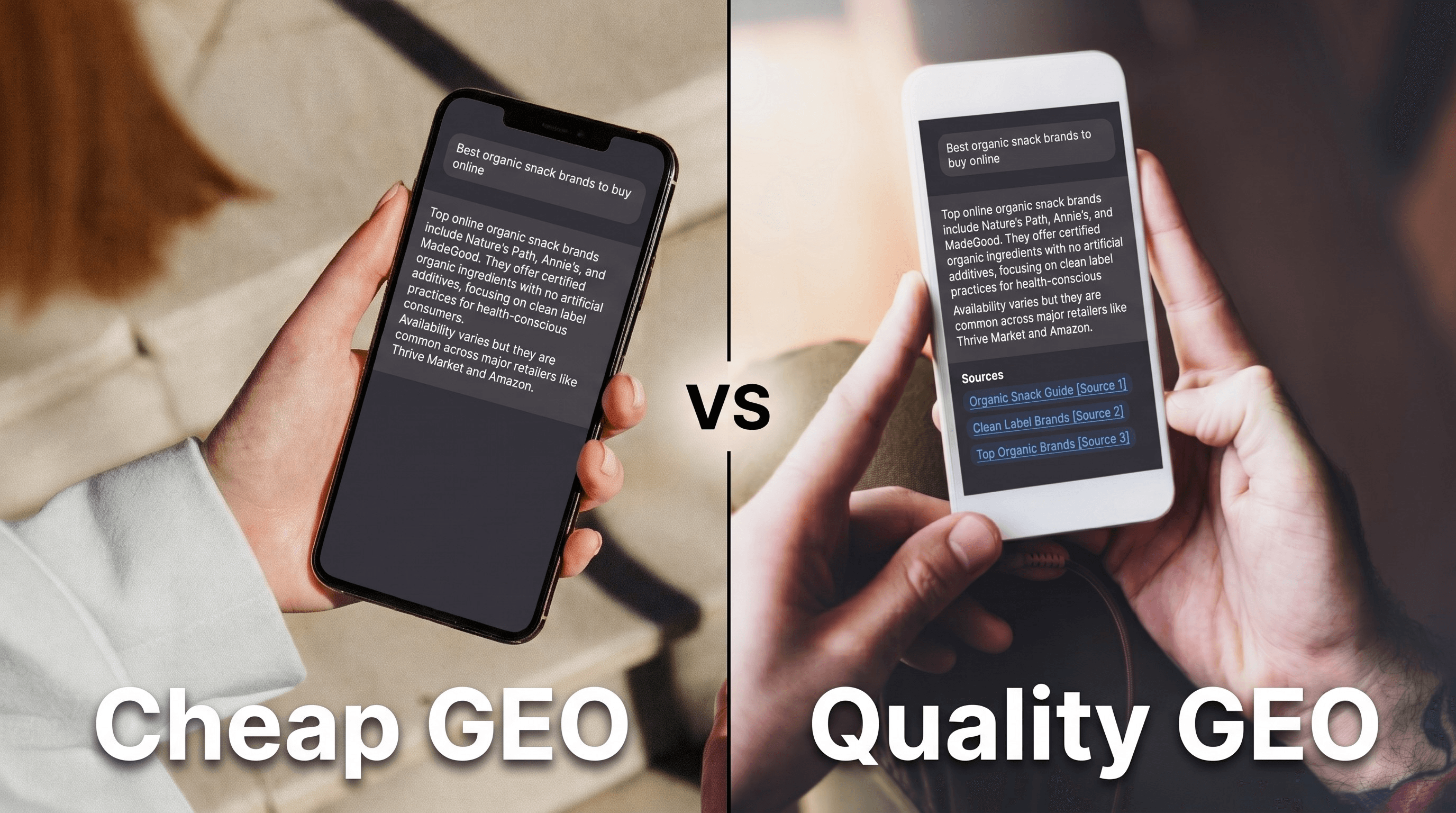
Why two GEO services with the same name can be completely different products, and how to tell which one you’re actually buying.
Cheap GEO and quality GEO wear the same label and cost wildly different amounts, because they aren’t the same work. Cheap GEO is usually automated content churned out at volume, aimed at one engine, with no authority building and no real measurement, and it tends to produce pages that never get cited. Quality GEO is human-led: content built to be quoted, technical work so AI can read your site, authority earned across the web, coverage of every major AI engine, and reporting tied to your actual visibility. The difference that matters isn’t the price. It’s whether the work can genuinely earn citations. Below is how to tell the two apart before you spend a dollar.
Is this guide for you? Read on if you’re comparing GEO providers and the quotes are all over the place, and you want to know what actually separates a bargain that wastes your money from work that earns your brand a place in AI answers. If you just want a price, that’s a different question. If you want to judge quality, not just cost, this is for you.
When you start shopping for GEO, the first thing you notice is that the prices don’t make sense. One provider quotes a few hundred dollars, another quotes several thousand, and both describe what sounds like the same service. It’s tempting to assume they’re selling the same thing and the cheaper one is simply a better deal. Usually, they aren’t, and it isn’t.
GEO is one of those things where the label hides enormous differences in the actual work. Two services can both be called generative engine optimization and share almost nothing in how they’re done or what they produce. So instead of comparing prices, this guide compares the work itself, dimension by dimension, so you can see exactly where cheap GEO and quality GEO part ways, and know which one a quote is really offering.
The content: churned out vs. built to be cited
This is the biggest divide. Cheap GEO leans on volume. It uses automation to produce a large number of pages quickly, lightly edited if at all, on the theory that more pages mean more chances to appear. The problem is that AI systems don’t cite pages for existing. They cite content that clearly and credibly answers a real question, and thin, templated pages give them no reason to. Quality GEO produces fewer pages that are genuinely worth quoting, built around the questions your customers actually ask AI tools, written with real substance and structured so an AI can lift a clean answer from them. One approach fills the internet with pages nobody cites. The other earns the citation. The page count looks impressive on the cheap side, right up until you check whether any of it shows up in an answer.
The approach: automation alone vs. judgment on top
Both cheap and quality GEO use AI, so “we use AI” tells you nothing. What separates them is whether a human is steering. Cheap GEO tends to be automation running largely unsupervised: a tool generates content and pushes it live with little strategic thought about what’s worth creating or whether it’s any good. Quality GEO uses AI for the heavy lifting, drafting, monitoring, analysis, but keeps experienced people making the decisions that matter: what to create, what to prioritize, what’s actually working, and what to fix. The technology is similar. The judgment layered on top is not, and that judgment is most of what you’re paying the difference for.
The scope: one engine vs. all of them
Your customers aren’t all asking the same AI. Some use ChatGPT, some Perplexity, some Google’s AI answers, some Gemini, and each works a little differently. Cheap GEO usually optimizes narrowly, often just for Google, and leaves the rest uncovered, which means large pockets of your audience never see you no matter how much content gets produced. Quality GEO works across every major engine, because that’s where your buyers actually are. The good news is that much of the trust-building work helps everywhere at once, but only if someone is deliberately covering the full landscape rather than aiming at a single target and hoping.
Authority: skipped vs. earned across the web
Here’s a step cheap GEO almost always skips, because it’s the hard part. AI systems decide what to trust partly by what the rest of the web says about you. A brand that only exists on its own site, with nothing pointing to it from elsewhere, gives an AI little reason to treat it as credible. Quality GEO builds that credibility deliberately, earning mentions, references, and presence across the wider web so that when an AI weighs whether to trust you, the evidence is there. Cheap GEO produces content in a vacuum and wonders why it isn’t cited. Quality GEO understands that citations are earned partly off your own site, and does the slower, harder work that authority requires.
Measurement: vanity or none vs. tied to real visibility
Ask a cheap provider how they’ll measure success and the answer is often vague, or it points to numbers that don’t matter, pages published, words written, keywords tracked. None of those tell you whether you’re actually showing up in AI answers. Quality GEO measures the thing that counts: your visibility across the AI engines, tracked over time, tied back to the work. That means you can see whether citations are increasing, where you stand against competitors, and whether the investment is paying off. If a provider can’t tell you how they’ll prove you’re getting cited, they’re probably not set up to get you cited in the first place. Measurement and results tend to come as a pair.
The result: pages that exist vs. citations that compound
All of these differences lead to two very different outcomes. Cheap GEO produces activity: a pile of pages, a busy-looking report, a sense that something is happening. What it rarely produces is citations, because none of the work was built to earn them. Quality GEO produces visibility that compounds, because AI systems lean harder on sources they already trust, so each month of real work makes the next citation a little easier to win. A year of cheap GEO often leaves you roughly where you started, minus the money. A year of quality GEO leaves you with an asset that keeps working. Same label, opposite results.
How to tell which one you’re being sold
You don’t need to be an expert to spot the difference. A few direct questions separate the two fast:
- How do you decide what content to create, and who reviews it before it goes live?
- Which AI engines do you optimize for, and how do you approach each?
- How do you build authority off my own site, not just on it?
- How will you measure and report my actual visibility in AI answers?
- Can you show me the difference your work has made for other brands?
Quality GEO answers all of these clearly and specifically. Cheap GEO gets vague, changes the subject to page counts, or leans on “our AI handles it” without detail. The discomfort under those questions is itself the answer, and it usually maps straight onto the price.
Why cheap GEO ends up the more expensive choice
The real cost of cheap GEO isn’t the low fee. It’s the time. GEO takes months to compound, so a year spent on work that was never going to earn citations isn’t just wasted money, it’s a wasted head start, while competitors doing it properly build a lead that gets harder to close. Then you pay again for the real thing, now further behind than when you started. The lowest price and the lowest cost are rarely the same. The goal isn’t to spend the most; it’s to buy work that can actually move your visibility, because anything less produces nothing no matter how little it costs. As a rough guide, real programs run from a few thousand dollars for a project to a few thousand a month for ongoing work, and a quote far below that is usually priced for volume, not results.
Where CommerceV3 fits
CommerceV3 is built for the quality end of this, without the quality-end overhead. You get GEO and AI search done properly, content built to be cited, authority earned across the web, coverage of every major engine, and reporting tied to your real visibility, run by one senior team under one roof for a single flat fee. Our AI-native model handles the volume work so senior operators can focus on the judgment that separates quality from cheap, which is how the work stays high-quality without costing a fortune. See the real ranges on our pricing page, and we do this for specialty and DTC ecommerce brands across food, gift, apparel, beauty, automotive, and B2B.
Find out if your current GEO is actually working
The fastest way to tell cheap GEO from quality GEO is to check whether you’re actually getting cited. Request CommerceV3’s free AI Visibility Assessment to see how often your brand shows up across ChatGPT, Google AI, Perplexity, and Gemini today, and how you compare to competitors. If you’ve been paying for GEO and the answer is “almost never,” now you know what you’re really buying. Request your assessment to see the truth.
Frequently Asked Questions
What’s the real difference between cheap and quality GEO?
The work, not the price. Cheap GEO is usually automated content produced at volume, aimed at one engine, with no authority building and no real measurement, so it produces pages that rarely get cited. Quality GEO is human-led: content built to be quoted, technical work, authority earned across the web, coverage of every major AI engine, and reporting tied to your actual visibility. Same label, very different products, and only one of them reliably earns citations.
Why is some GEO so much cheaper than the rest?
Because it’s doing far less, or doing it with automation and no human judgment. A very low price usually means content churned out in volume, a single engine targeted, no authority work, and no meaningful measurement. That’s cheaper to deliver, but it’s also the version least likely to earn citations. The price gap between providers usually reflects a real gap in the work, not a better deal on the same service.
Does cheap GEO ever work?
Rarely, in the way that matters. It can produce a lot of pages and a busy-looking report, but AI systems cite content that genuinely answers questions from sources they trust, and cheap GEO tends to produce neither. Occasionally a low-cost provider is a genuinely efficient operator, but far more often a rock-bottom price signals thin, automated work. The test isn’t the price, it’s whether the work can actually get you cited, and cheap GEO usually can’t.
How can I tell if a GEO provider is any good?
Ask how they decide what to create and who reviews it, which engines they cover, how they build authority off your own site, and how they’ll measure your real visibility in AI answers. A quality provider answers all of that clearly. A cheap one gets vague, points to page counts, or hides behind “our AI handles it.” How they respond to those questions tells you almost everything, and it usually lines up with where their price sits.
Is expensive GEO always better than cheap GEO?
Not automatically, but there’s a floor below which the work can’t really succeed. Price alone doesn’t guarantee quality; you still want to see human judgment, full engine coverage, authority building, and real measurement. What price does tell you is whether there’s enough investment for those things to happen at all. A very cheap quote almost never leaves room for them, while a fair price makes quality possible, if the provider is genuinely doing the work.
I think I’ve been paying for cheap GEO. What now?
Check the results first. Look at whether your brand actually shows up in AI answers today, since that’s the real test of whether the work has been worth anything. If you’re barely cited after months of paying, the work likely wasn’t built to earn citations, and continuing won’t fix that. The better move is to switch to quality work that measures real visibility, and treat the earlier spend as a lesson rather than a sunk cost worth protecting.