
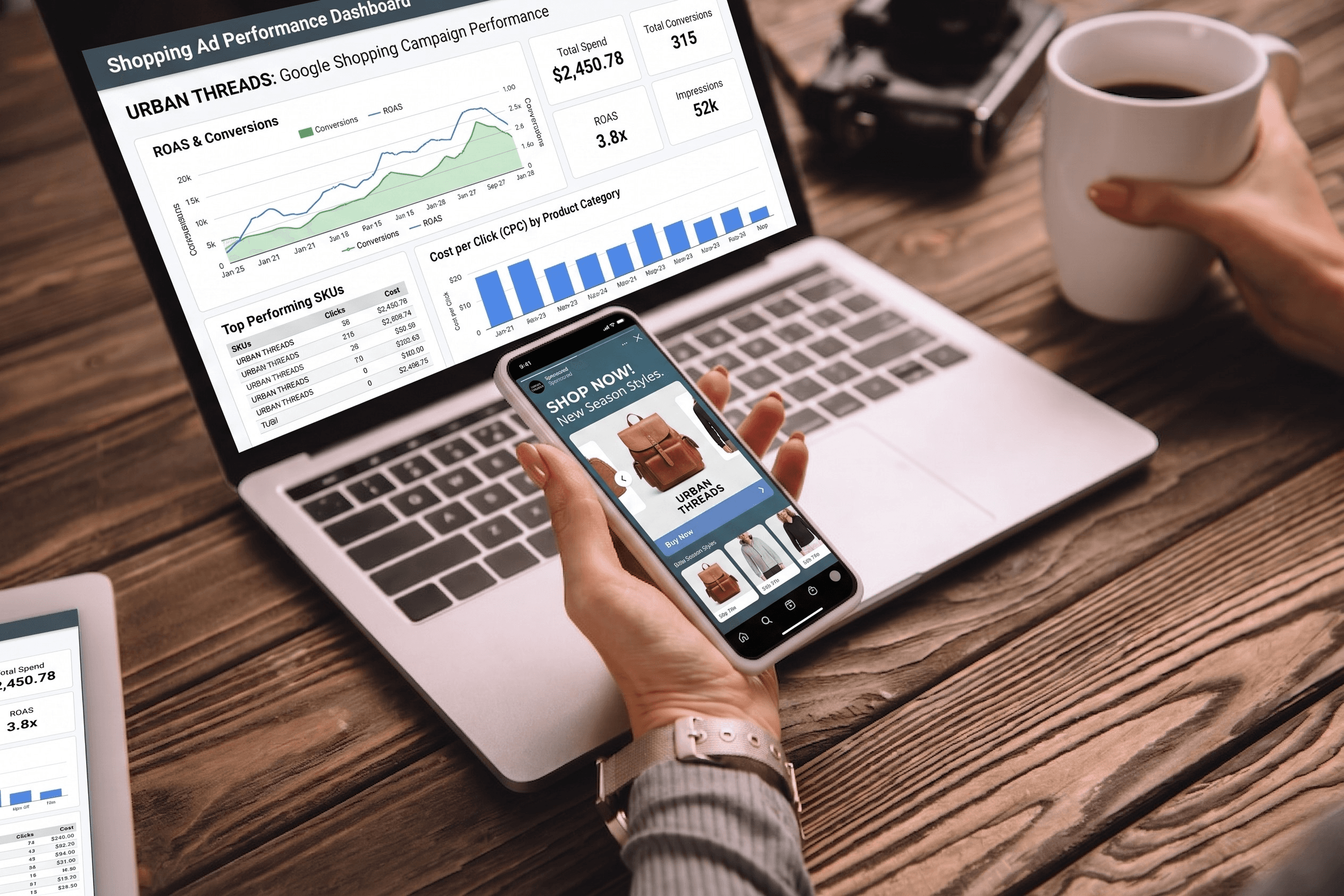
Shopping ads are the highest-leverage paid channel in ecommerce. They show your product image, price, and store name directly in Google search results, where shoppers are already in buying mode. Most ecommerce brands run them. Most do not optimize them properly. The result is a campaign that spends consistently but never seems to scale.
This guide walks through Shopping ads optimization in 2026, from product feeds and campaign structure to bidding, creative, and the new AI-powered campaign types Google rolled out this year. Written for ecommerce store owners who want predictable revenue from Shopping, not a black-box budget drain.
Why are Shopping ads so important for ecommerce?
Shopping ads are not just one of the channels you can run. They are the channel for ecommerce paid acquisition.
The numbers tell the story:
- Shopping ads drive 76 percent of retail search ad spend
- Google Shopping accounts for roughly 85 percent of all Google Ads clicks for ecommerce
- Shopping ads convert at 30 percent higher rates than text ads
- Average CPC sits at $0.66 across most ecommerce categories
- Average ROAS for Search-style Shopping campaigns is around 5:1, compared to 2.5:1 for Performance Max
When someone searches “running shoes for flat feet” or “organic gluten-free granola,” Google Shopping shows them a product image, price, store name, and rating before they click. That visual product-first format is why Shopping converts so much better than text ads — shoppers see what they are buying before they leave the search page.
For ecommerce brands already running Google Ads, Shopping should be the dominant share of spend. If it is not, that is usually the first sign your account architecture needs work.
What is the difference between Standard Shopping and Performance Max?
Two campaign types can run Shopping ads. They work differently and serve different jobs. Most ecommerce brands need both.
Standard Shopping gives you control. You see search queries, control bids, segment by product, and get clean attribution data. It runs only on Search and Shopping. It is the right tool when you want ROAS discipline on your best-converting products.
Performance Max runs across all Google properties — Search, Shopping, YouTube, Display, Gmail, Discover. You upload a budget and conversion goal, and Google’s AI handles the rest. You get reach and audience expansion, but you give up granular control. It is the right tool for new product launches, audience prospecting, and broader reach once your data signals are strong.
The 2026 reality is split. Across thousands of ecommerce brands, Search-style Shopping campaigns average around 5:1 ROAS while Performance Max averages around 2.5:1. That gap is not because Performance Max is broken. It is doing a different job: broader reach, upper-funnel inventory, and new audience prospecting. Treating Performance Max as a replacement for Shopping is the most common scaling mistake.
The right pattern for most ecommerce brands:
- Run Standard Shopping for your top-converting and highest-margin products
- Run Performance Max for new product launches and broader reach
- Use both in parallel, not in sequence
How important is product feed quality for Shopping ads?
Your product feed is the ad. Every Shopping listing pulls its title, image, price, availability, and attributes directly from your Merchant Center feed. Optimizing the feed is the single highest-leverage move you can make in Shopping ads. A well-optimized feed can expand impression share by 40 to 60 percent without changing a single bid.
What feed optimization actually means:
- Complete attributes for every product (GTIN, MPN, brand, category, condition)
- Accurate inventory and pricing synced in real time
- Optimized titles that lead with the product name and key attributes
- High-quality images that meet Google’s strict requirements
- Detailed descriptions that match how shoppers search
For stores managing thousands of SKUs, AI-generated product descriptions edited for accuracy are the fastest way to ship optimized feed copy at scale without burning out your team.
The brands that nail feed quality often see CPCs drop and impression share grow within 4 to 6 weeks, before any bidding strategy changes.
How do you write Shopping ad titles that actually rank?
Product titles are the most important element in your feed. Google’s algorithm uses them to match your products to search queries, and shoppers use them to decide whether to click. Most ecommerce stores publish default titles that look like this:
“Running Shoes”
A title that ranks and converts looks like this:
“Nike Air Zoom Pegasus 41 Men’s Running Shoes — Black/White — Size 9”
Best practices for Shopping ad titles:
- Lead with the brand name (highest-converting attribute)
- Include the product type, model, and key attributes (size, color, material)
- Use the same words shoppers actually search for, not internal jargon
- Keep total length under 150 characters, with the most important words in the first 70
- Pull terminology from your Search Terms Report to match real queries
What to avoid:
- Promotional words like “Best,” “Cheapest,” “Free Shipping,” or “Sale” — they violate Google’s policies and trigger disapprovals
- Repeating the same keyword multiple times
- ALL CAPS, which Google flags as low quality
- Irrelevant attributes that pad the title without helping match intent
A specialty food brand using “Carolina Reaper Hot Sauce — Small Batch — Gluten-Free — 5oz Bottle” will outperform “Hot Sauce” in both impressions and CTR. The keyword density plus the specific attributes pre-qualify the click.
How should you optimize images for Shopping ads?
Product images are the most visually prominent element of a Shopping ad. Shoppers make split-second decisions based on image quality before reading titles or checking prices.
Best practices for Shopping ad images:
- Use clean, white-background primary images at minimum 800×800 pixels (ideally 1500×1500)
- Submit 3 to 5 additional images: lifestyle shots, close-ups, size comparisons, packaging
- Use descriptive filenames before upload (
nike-pegasus-41-black-running-shoes.jpg, notIMG_4521.jpg) - Compress to keep file sizes manageable without sacrificing quality
- Avoid watermarks, promotional overlays, or text directly on the image
A/B testing across categories consistently shows that clean white-background images outperform lifestyle images as the primary Shopping listing image. Lifestyle images work better as supplementary images and inside Display and YouTube placements within Performance Max. Save the lifestyle photography for those formats and keep your primary Shopping image clean.
What campaign structure works best for Shopping ads?
Running all your products in one campaign with one budget tells Google’s algorithm nothing about which products matter. The result is wasted spend on low-margin products and underspent on bestsellers.
The campaign structure that scales:
- Tier products by performance — separate your top performers (“Superstars”), your steady contributors (“Workhorses”), and your unproven products (“Scouts”) into different campaigns or product groups
- Use custom labels in your feed — label products by margin tier, seasonality, hero status, or stock level, then use those labels for bid segmentation
- Set campaign priorities — High, Medium, and Low priorities let you steer traffic across campaigns (for example, High priority for generic queries with tighter bids)
- Build account-level negative keyword lists — add irrelevant terms once and apply them across every campaign
This structure unlocks better data and better budget allocation. A campaign mixing your bestseller and your slowest-moving product cannot tell Google that the bestseller deserves more aggressive bidding. Splitting them out can.
Which bidding strategy works best for Shopping ads?
Manual bidding is dead for Shopping in 2026. Google’s automated bidding now significantly outperforms manual for almost every advertiser, but only after you have enough conversion data for the algorithm to learn from.
The right bidding sequence:
- Brand-new account, no conversion data — start with Maximize Clicks with a CPC cap to build data
- 15 to 30 conversions banked in 30 days — switch to Maximize Conversion Value for early scaling
- 50+ conversions — move to Target ROAS, segmenting by product margin tier
- Established campaigns — separate target ROAS values for Superstar (lower target, more spend) and Scout (higher target, conservative scaling) tiers
A few rules that separate the winners:
- Do not switch bidding strategies more than once every 14 days. Each change resets Google’s learning.
- Calibrate target ROAS to your actual margins, not industry benchmarks. A 4:1 ROAS is healthy on a 60% margin product. The same number is bleeding money on a 20% margin product.
- Use enhanced conversions to recover signal lost to cookie restrictions. This often improves reported conversions by 5 to 15 percent.
These bidding shifts often produce the biggest single performance lift in Shopping account audits, especially when paired with proper conversion tracking and feed optimization.
How does AI Max for Shopping change optimization in 2026?
Google rolled out AI Max for Shopping in 2026 as the next evolution of Shopping campaigns. It uses Gemini-powered AI to expand reach across more search queries, automatically select the best ad format (Shopping or text) for each query, and optimize creative variations on the fly.
What AI Max actually does:
- Final URL Expansion — sends traffic to the most relevant landing page on your site, even if it is not the page you initially specified
- Optimal Format Selection — automatically chooses between Shopping and text ad formats based on what fits the shopper’s query best
- Cross-format optimization — keeps your existing product targeting and bidding flexibility, with the option to disable expansion if needed
This works alongside the broader AI shopping journey reshaping search, where AI Mode and Gemini-powered experiences increasingly mediate between shoppers and retailers.
Most ecommerce brands should test AI Max on a subset of campaigns before rolling it out account-wide. The performance is generally strong but uneven across categories — luxury, high-consideration products tend to see less lift than fast-moving consumer goods, where intent matching is more straightforward.
How do you protect against wasted spend in Shopping ads?
Shopping ads scale fast in both directions. A poorly structured campaign can burn budget on irrelevant searches just as easily as a well-structured one can compound returns. The patterns that drain budget:
- Irrelevant search queries — review your Search Terms Report weekly and add negative keywords aggressively
- Out-of-stock products still serving — enable Automatic Item Updates in Merchant Center to suppress out-of-stock SKUs
- Disapproved products — check Merchant Center diagnostics regularly and fix issues via supplemental feeds
- Branded queries running through generic campaigns — exclude your brand terms from generic Shopping campaigns and run them through a dedicated brand campaign with lower target ROAS
- Stale creative in Performance Max — refresh asset groups every 60 to 90 days, since creative fatigue is a silent ROAS killer
For brands running Shopping alongside other paid channels, combining paid ads with SEO and email so the channels reinforce each other usually compounds returns more than tweaking Shopping in isolation.
What metrics actually matter in Shopping ads?
Most Shopping account audits surface the same problem: too many vanity metrics being tracked, not enough revenue metrics. The metrics that matter:
- ROAS (Return on Ad Spend) — your core ecommerce metric, segmented by product tier
- Conversion value per click — better than CTR for understanding which clicks are worth paying for
- Click share and impression share — how much of the available auction you are capturing
- Search Lost IS (Budget) and Search Lost IS (Rank) — tells you whether you are missing impressions due to budget or bidding
- Cost per acquisition — tied to your customer acquisition cost goals
- Profit on ad spend (POAS) — increasingly the metric serious ecommerce brands optimize toward, since ROAS does not account for product margins
A campaign with high ROAS on low-margin products may still be losing money. A campaign with moderate ROAS on high-margin products may be highly profitable. POAS captures what ROAS misses.
When should you bring in help to manage Shopping ads?
Shopping ads are learnable. Plenty of ecommerce founders run their own Shopping campaigns and do well. The challenge is that Shopping rewards continuous, daily optimization across feed health, campaign structure, bidding, and creative. Brands that optimize weekly are structurally disadvantaged against those running always-on management.
Hire help when:
- Your monthly Shopping spend exceeds $5,000 and the cost of inefficiency is meaningful
- You have more than 1,000 SKUs and manual feed optimization is too slow
- Your ROAS has plateaued for 60+ days despite changes
- You want to integrate Shopping with SEO, email, and broader growth channels so paid does not run in isolation
- You need someone to tie campaign data back to broader conversion rate and customer acquisition cost goals
- You are scaling and want a partner who can grow with you
A strong ecommerce PPC management services partner does more than push buttons in the Google Ads interface. They tie Shopping spend to your full-funnel strategy and treat ad performance as one part of total revenue.
Frequently asked questions about Shopping ads optimization
What is a good ROAS for Shopping ads?
It depends entirely on your margins. A 4:1 ROAS is healthy for stores with 50 to 60 percent margins. Stores with thinner margins on commodity products may need 6:1 or higher to be profitable. Stores with high lifetime value, like subscriptions, can profitably run lower ROAS like 2:1 or 3:1 because they recoup the customer over multiple purchases. The right target is whatever covers your true unit economics, not what an industry benchmark says.
How long does it take to see results from Shopping ads?
Most ecommerce brands see meaningful traction within 30 to 60 days. The first 2 to 3 weeks are usually about feed approval, campaign learning, and adding negative keywords. By week 4 to 6, automated bidding has enough data to optimize. By month 2 to 3, ROAS becomes consistent enough to scale. Brands expecting profitable Shopping in week one are usually disappointed.
Should I use Performance Max or stick with Standard Shopping?
Use both. Standard Shopping gives ROAS control on your top-converting products. Performance Max gives reach and prospecting on new launches and lower-priority SKUs. The 50/50 split is roughly the right pattern for most ecommerce brands in 2026. Treating Performance Max as a Standard Shopping replacement is the most common scaling mistake.
How often should I update my product feed?
Real-time inventory and pricing should sync continuously. Title, description, and image updates should happen at least monthly, ideally weekly for high-velocity products. Use supplemental feeds in Merchant Center to override or enrich primary feed data without rebuilding it from scratch. Stale feeds lead to disapprovals, wasted spend, and poor shopper experience.
Do I need to be on Google Merchant Center to run Shopping ads?
Yes. Merchant Center is where your product feed lives, where Google validates your products, and where you set up free listings, paid Shopping, and Buy on Google. There is no Shopping campaign without it. The 2026 version, Merchant Center Next, has consolidated free listings, paid Shopping, and product management into a single dashboard.
What is the biggest Shopping ads mistake brands make?
Treating Shopping as set-and-forget. Shopping rewards daily optimization across feed quality, search terms, bidding, and creative. Brands that check their account weekly are structurally behind those running continuous optimization. The second biggest mistake is running every product in a single campaign with one budget, which gives Google’s algorithm no signal about which products deserve more aggressive bidding.
Scale your Shopping ads results with CV3
CV3 brings your platform, paid search, and broader growth strategy under one roof so your Shopping campaigns stay connected to the rest of your store, not running in isolation. Our Platform plus Agency model gives you:
- A flexible storefront where product feeds, inventory, and conversion tracking flow cleanly between systems
- An ecommerce PPC management services team that runs Shopping, Performance Max, and AI Max campaigns with revenue accountability
- An ecommerce search engine optimization agency and email marketing services team working alongside paid so SEO, email, and Shopping reinforce each other
- A growth team that helps you decide where to invest next across paid, SEO, email, and onsite optimization
If you want a partner who treats Shopping as a revenue lever instead of a feature checklist, talk to CV3 about scaling your Shopping ads.