
A year ago this was your worst-performing traffic. Now it’s your best. Here’s what flipped, and what to do about it.
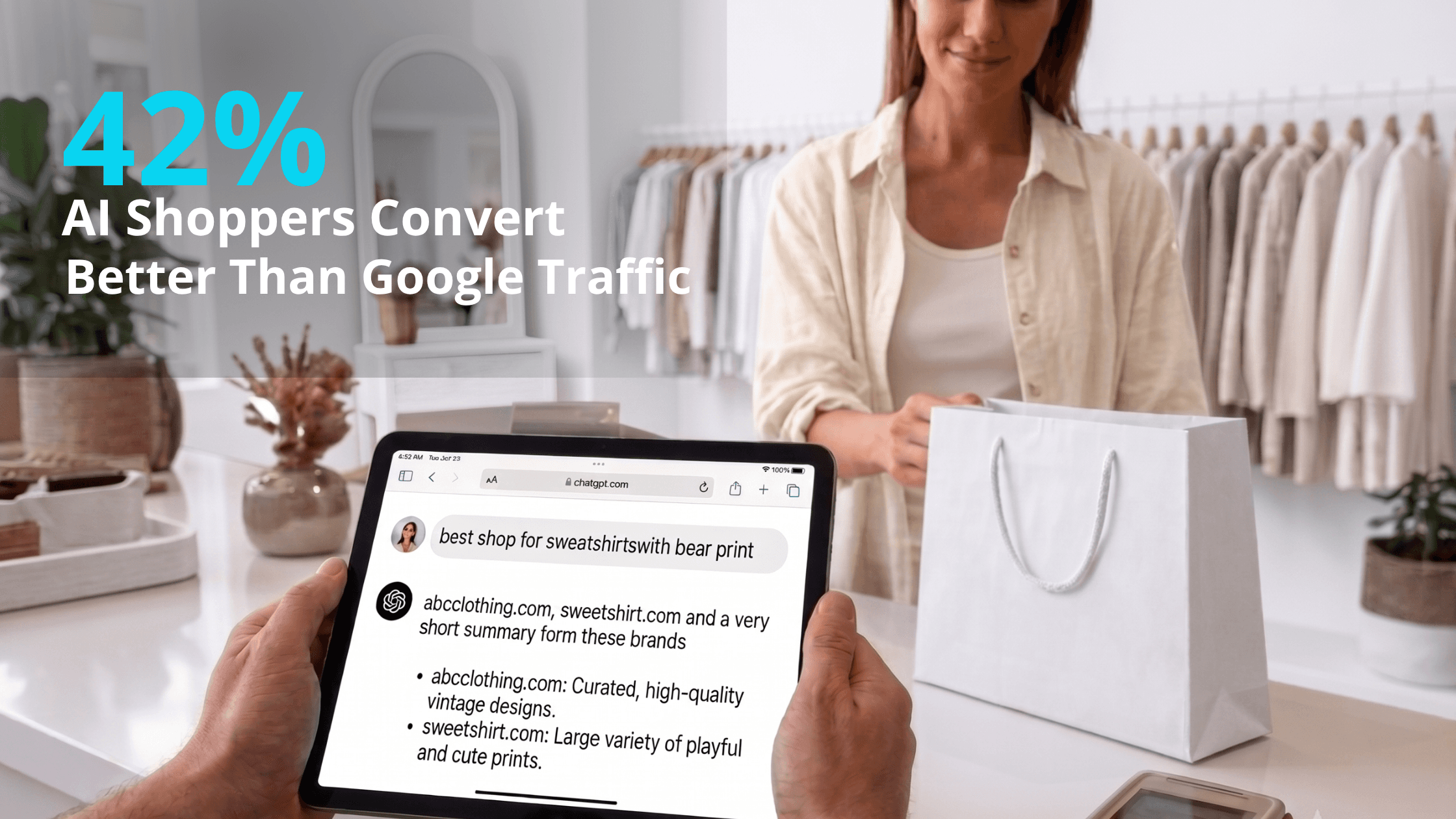
Shoppers who arrive from AI tools now convert around 42% better than your regular traffic, according to Adobe. The odd thing is that a year earlier the same traffic converted worse. It flipped. The reason comes down to intent: by the time an AI hands someone off to your store, it has already done the researching and comparing that a normal shopper does across a dozen open tabs, so they land much closer to actually buying. There’s a catch, though. None of this helps you unless your brand shows up in those AI answers in the first place, and unless your store is ready to close a visitor who has already half-decided. Both have to be true.
Is this guide for you? Read on if you sell online and you keep hearing that AI traffic matters but aren’t sure whether it’s hype or something to act on. If you’ve already got AI visibility dialed in and you’re measuring it cleanly, you’re ahead of nearly everyone. If not, the next few minutes are worth it.
A year ago, if you’d told most store owners that traffic from AI tools was worth chasing, they’d have shrugged. And honestly, fair enough. Back then it converted worse than almost anything else. People would arrive from some chatbot answer, click around for a bit, and leave without buying.
Then, quietly, over the course of about twelve months, that turned completely around.
Adobe’s analytics now put AI-referred shoppers at roughly 42% higher conversion than traditional traffic. Rewind to early 2025 and that same group converted almost 40% worse. So in the space of a year, the worst-performing traffic on a lot of stores became the best. That doesn’t happen often, and it’s worth understanding why, because the brands that get it are already quietly reorganizing around it.
What actually flipped
The number is dramatic, but the cause is pretty simple once you look at it.
Early on, AI tools were mostly a novelty. People asked them questions, got sent somewhere, and treated the whole thing as an experiment. Low commitment, lots of curiosity, not much buying. That’s your 38%-worse crowd.
What changed isn’t really the technology. It’s the behavior. People now trust these tools enough to shop with them properly, and they use them further down the buying journey, at the point where they’re comparing real options and getting close to a decision. Different moment, different shopper, completely different result.
Why someone from an AI answer is closer to buying
Think about how you’d normally research a bigger purchase. You open a search, then a comparison article, then three product pages, then a Reddit thread, then back to a product page. Somewhere in that mess you make up your mind. It takes a while and half of it is you doing the sorting.
An AI collapses most of that. By the time it points someone at your store, it has already done a chunk of the work for them:
- It understood what they actually wanted, in plain language, follow-up questions and all.
- It sifted the options and put yours forward as a genuine fit, not just a keyword match.
- It handled a lot of the comparing, so the shopper arrives with fewer doubts left to talk themselves out of.
So the person landing on your page isn’t a browser who stumbled in. They’ve been pre-qualified by something that just told them you’re a good answer to their question. Of course they convert better. They showed up most of the way to a yes.
Here’s the part that’s easy to miss
All of that upside comes with one hard condition. You only get any of this traffic if the AI recommends you in the first place.
Read that again, because it’s the whole game. A 42% conversion lift on visitors you never receive is worth exactly nothing. If a shopper asks ChatGPT or Perplexity for the best option in your category and your brand doesn’t come up, that beautifully pre-qualified, ready-to-buy customer goes to whoever did get named. You never even see them leave, because they were never yours to lose.
This is where a lot of brands are quietly falling behind without realizing it. They’re still pouring effort into channels they can measure, while the highest-intent traffic in ecommerce flows to competitors who happened to do the work of being visible in AI. It’s not that they’re losing the sale at checkout. They’re losing it before the shopper ever arrives.
What it looks like on a real store
Picture a shopper hunting for a gift for their coffee-obsessed sister. A year ago they’d have opened five tabs, read a couple of “best gifts for coffee lovers” posts, and eventually landed somewhere. Now they just ask an AI, describe her, and get a short, confident list back.
If your pour-over set is on that list, here’s what happens. They click through already sold on the idea, skim your page to confirm it’s the right thing, and buy. Minutes, not days. That’s the 42% in action.
If your set isn’t on that list, none of that happens for you. It happens for a competitor, and you never see the shopper at all. Same product, maybe a better one, but you weren’t in the room when the AI made its shortlist. That’s the whole difference between the two outcomes, and it’s decided before anyone lands on a page.
So what do you actually do about it?
Three things, roughly in order of importance.
First, make sure you show up in AI answers at all. This is the non-negotiable one, and it’s the work of getting your brand to be the one AI trusts and cites. Without it, everything else here is theoretical. If you’re not sure whether you show up today, that’s the first thing to find out, not guess at.
Second, get your store ready for a high-intent visitor. These shoppers arrive close to deciding, so a slow page, a confusing product description, or a clunky checkout does more damage than usual, because you’re fumbling a customer who was ready to buy. This is the difference between earning the traffic and wasting it.
Third, learn to actually see this traffic. A lot of AI-driven visits get logged as “direct” in standard analytics, so plenty of brands are already getting AI sales and crediting them to the wrong place. If you can’t see the channel, you’ll keep underinvesting in it. Watch how your direct traffic, branded searches, and overall sales move as your AI visibility grows, and you’ll start to spot it.
A quick reality check
None of this means Google is dead or that you should yank budget out of everything else tomorrow. Let’s keep it honest.
In raw volume, AI traffic is still the small channel on most stores. It’s growing fast, and it’s unusually valuable per visit, but it isn’t carrying your whole business yet. The smart read isn’t “drop everything for AI.” It’s “this is the fastest-growing, highest-intent traffic you can get, and it’s cheap to win right now because most of your competitors are asleep on it.” Early is the advantage here. In two years this will be table stakes and a lot more crowded. Today it isn’t.
And if you take one thing from all of this, make it the boring-sounding middle step: being visible in AI and being ready to convert are two different jobs, and you need both. Plenty of brands will nail one and quietly waste the other.
The brands that treat this seriously right now aren’t doing anything exotic. They’re just making sure they show up when the AI builds its shortlist, and that their store doesn’t fumble the shopper it sends. That’s it. It sounds almost too simple, which is probably why so many stores still haven’t done it.
Where CommerceV3 fits
Winning this traffic means doing two things well at once, and most brands have them sitting with different people who never talk. CommerceV3 runs both under one roof. Our GEO and AI search work gets you showing up in the AI answers where these shoppers start, and our conversion work makes sure your store actually closes them once they arrive. Because it’s one senior team rather than a stack of vendors, the visibility and the conversion pull in the same direction instead of pointing fingers when the numbers dip. We do this for specialty and DTC ecommerce brands across food, gift, apparel, beauty, automotive, and B2B.
First, find out if you’re even getting this traffic
Before you can capture the best-converting traffic in ecommerce, you need to know whether the AI is sending it your way at all. Request CommerceV3’s free AI Visibility Assessment and we’ll show you how often your brand comes up across ChatGPT, Google AI, Perplexity, and Gemini right now, and how you stack up against the competitors getting named instead. Request your assessment and see where you really stand.
Frequently Asked Questions
Do shoppers from AI tools really convert better?
Yes. Adobe’s data puts AI-referred conversion at roughly 42% higher than traditional traffic, a sharp reversal from a year earlier when it actually converted worse. The reason is intent. AI tools now do a lot of the researching and comparing before they send someone to your store, so those visitors arrive much closer to buying than a typical browser. Worth checking on your own site too: if your AI-referred conversion rate isn’t beating your search traffic, your product pages probably aren’t handling that high-intent visitor well.
Why did AI traffic go from converting worse to converting better?
Behavior changed, not the technology. Early on, people treated AI tools as a novelty and poked around without much intent to buy, so that traffic underperformed. Now they trust these tools enough to shop with them seriously, and they use them later in the buying journey, at the comparing-and-deciding stage. Same source, very different shopper, which is why the conversion rate flipped so hard in about a year.
What’s the catch with this high-converting AI traffic?
You only get it if the AI recommends you. A 42% conversion lift means nothing on visitors you never receive, and if your brand doesn’t come up when someone asks an AI for the best option in your category, that ready-to-buy shopper simply goes to whoever did get named. The traffic is exceptional, but being visible in AI answers is the price of entry, and plenty of brands are quietly missing out without realizing it.
Should I move my budget from Google to AI?
Not wholesale. AI is still the smaller channel by raw volume on most stores, even though it’s growing fast and converts unusually well. The sensible move isn’t abandoning what works, it’s investing in AI visibility early while it’s cheap and most competitors are ignoring it. Think of it as claiming ground now that will be far more expensive and crowded in a couple of years, rather than betting the whole business on it today.
How do I know if I’m already getting AI traffic?
Look closely at your “direct” traffic, because a large share of AI-driven visits get misattributed there in standard analytics. Many brands are already making AI sales and crediting them to the wrong place. Beyond that, watch how branded searches and overall sales move as your AI presence grows. The cleanest starting point is an AI visibility check, which tells you directly whether you’re showing up in the tools people are shopping with.
What should I fix first to capture AI shoppers?
Start with visibility, since you can’t convert traffic you don’t receive. Get your brand showing up in AI answers first. Then make sure your store is ready for a high-intent visitor: fast pages, clear product information, and an easy checkout, because these shoppers arrive ready to buy and a clumsy experience wastes that. Doing both is the whole point, and skipping either one leaves most of the opportunity on the table.