
The automated emails that quietly earn most of a store’s email revenue, what each one does, and the order to build them in.
Is this guide for you? Read on if you run an online store and your email marketing is mostly one-off campaigns, with few or no automations running in the background. If you already have all eight of these flows live and optimized, you’re ahead of most. If some are missing, that’s revenue sitting on the table.
Most stores think of email as the newsletter. You write something, you send it to everyone, you hope for sales. That’s a campaign, and campaigns have their place. But they’re not where the real money is.
The money is in flows: automated emails triggered by what someone actually does. A person joins your list, abandons a cart, makes a purchase, goes quiet. Each of those moments is a signal, and a flow is simply the right email showing up at the right moment in response. Set them up once and they run on their own, quietly earning while you sleep. For a lot of stores, a handful of well-built flows end up driving a large share of all email revenue, off a fraction of the effort campaigns take.
So here are the eight every store should have. You don’t need to build them all at once, and I’ll say which to start with at the end. But over time, these are the ones that matter.
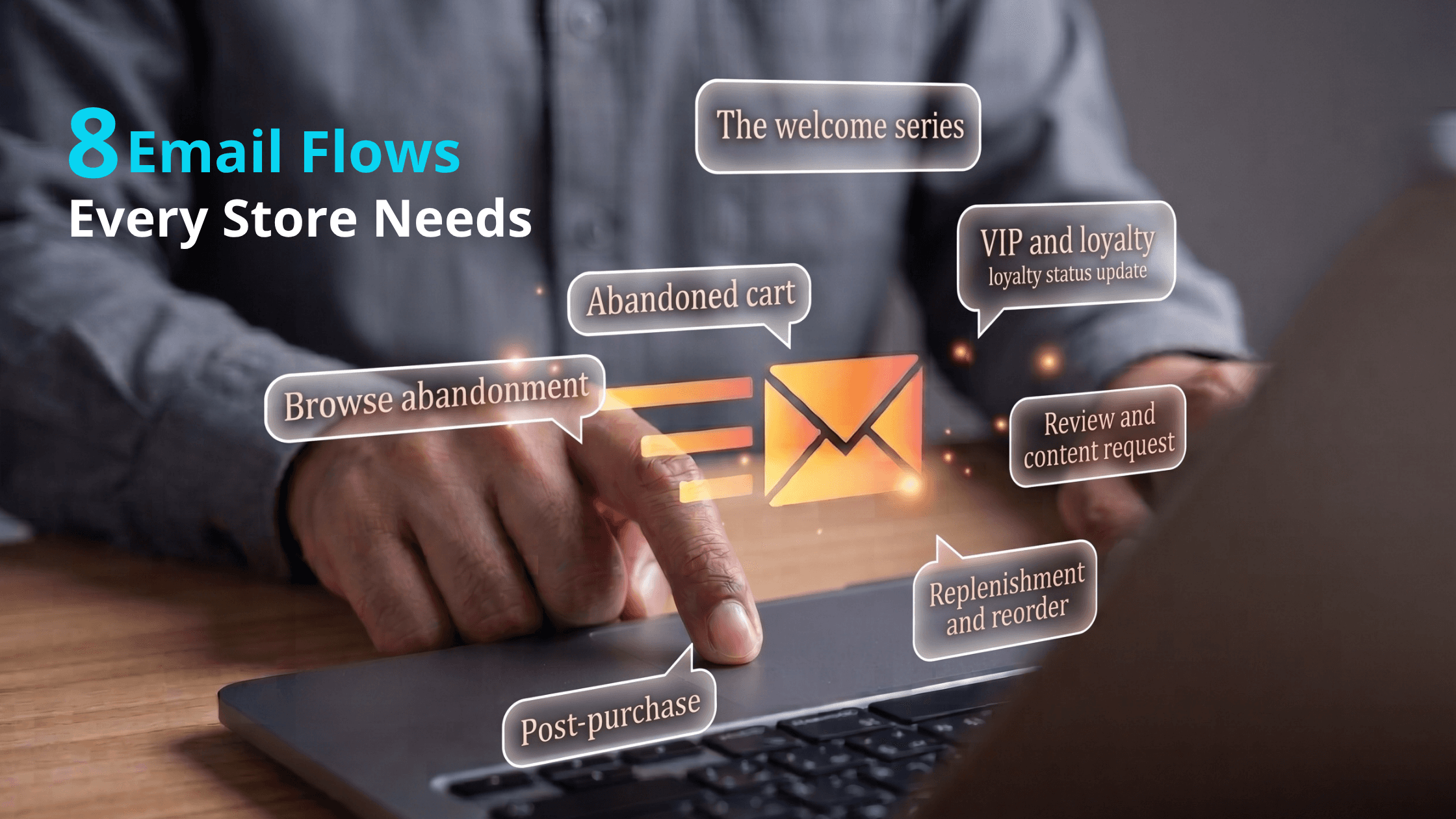
1. The welcome series
Someone just signed up. They’re more interested in you right now than they may ever be again, and a single “thanks for subscribing” email wastes that moment. A welcome series, usually three or so emails over the first few days, introduces your brand, tells your story, sets expectations, and gently nudges toward a first purchase, often with a small incentive. It’s typically one of the highest-converting flows you’ll ever run, purely because it catches people at peak curiosity. If you build only one flow, build this.
2. Abandoned cart
This is the famous one, and for good reason. Someone added items, got to the edge of buying, and left. They were interested enough to fill a cart, so a well-timed reminder recovers a meaningful slice of those almost-sales.
A good version isn’t just one nagging email. It’s a short sequence: a gentle reminder within an hour or two, then a follow-up a day later that handles hesitation, addresses a common objection, adds a review, or offers a little push. Done right, this flow alone can pay for your whole email program.
3. Browse abandonment
The quieter cousin of the abandoned cart, and the one most stores skip. Here, someone browsed products, showed clear interest, but never added anything to a cart. They didn’t get as far, so the intent is softer, but it’s still there. A light, helpful nudge, “still thinking about this?”, catches shoppers earlier in the decision than cart recovery does. Keep it softer than your cart flow, since these people are earlier in their thinking, but don’t ignore the signal. It’s real interest going to waste.
4. Post-purchase
Most stores stop paying attention the moment someone buys, which is exactly backwards. A customer who just purchased is the warmest audience you have, and the post-purchase flow is where a one-time buyer starts becoming a repeat one.
This flow does a few jobs at once. It confirms the order and keeps them updated so they’re not left wondering. It helps them get the most out of what they bought, tips, how-tos, what to expect. And it quietly builds the relationship that makes the second purchase feel natural. Handled well, it turns a transaction into the start of something, rather than the end of it.
5. Review and content request
A little while after the product has arrived and they’ve had a chance to use it, ask for a review. It’s a simple flow with an outsized payoff, because reviews and customer photos are some of the most persuasive content you have. They convince future shoppers, and, increasingly, they feed the trust signals that AI tools weigh when deciding which brands to recommend. Time it so the customer has actually experienced the product, keep the ask easy, and you’ll steadily build a library of social proof that keeps working long after the email is sent.
6. Replenishment and reorder
If you sell anything people run out of, coffee, supplements, skincare, pet food, this flow is close to free money. You already know roughly how long a purchase lasts, so you email the customer right around the time they’re running low, when a reorder is genuinely useful rather than pushy. It’s helpful and profitable at the same time, which is a rare combination. If your products don’t get consumed, a gentler version still works: a “time for a refresh” nudge timed to when someone might realistically want more.
7. Win-back
Some of your past customers have quietly drifted away. They haven’t bought in a while, they’ve gone cold, and left alone they’ll fade out entirely. A win-back flow reaches out before that happens, with a “we miss you,” a reminder of what they liked, and often an incentive to come back.
Winning back a lapsed customer is almost always cheaper than acquiring a brand-new one, which is what makes this flow worth the effort. And there’s a natural end to it: if someone ignores several attempts, it’s a signal to stop emailing them so heavily and protect your deliverability, rather than keep shouting at someone who’s moved on.
8. VIP and loyalty
Not all customers are equal, and your best ones deserve to be treated like it. A VIP flow identifies the people who buy often or spend the most and rewards them, early access, a thank-you, a perk, a bit of recognition. It costs little and does two things at once: it makes your most valuable customers feel valued, and it nudges the people just below that tier to buy their way into it. In a world where holding on to a good customer matters more every year, this is the flow that quietly protects your most important relationships.
A couple worth adding once the eight are solid: a back-in-stock alert, which turns a sold-out disappointment into a recovered sale the moment you restock, and a birthday or anniversary email, a small, personal touch that consistently earns well for the effort it takes. Neither is essential on day one, but both are easy wins later.
Don’t build all eight at once
Eight flows can feel like a mountain, so don’t try to scale it in a weekend. There’s a sensible order.
Start with the two that pay back fastest: the welcome series and the abandoned cart. Between them, they catch people at their two highest-intent moments, and they’ll often cover the cost of everything else. Once those are running well, add post-purchase and review requests, because turning first-time buyers into repeat ones is where durable growth comes from. Then layer in browse abandonment, replenishment, win-back, and VIP as you go. Each one you add is a bit more revenue running on autopilot, so build steadily rather than all at once, and actually finish each flow before starting the next.
Why this matters more in 2026
Flows have always earned their keep, but they matter more now than they used to. Acquiring a new customer keeps getting more expensive, and a growing share of new shoppers are arriving through AI tools that are good at sending you a first-time buyer but do nothing to bring them back. That second part is on you.
Which means the store that wins isn’t just the one that gets discovered. It’s the one that turns that hard-won first sale into a second, third, and fourth. Flows are the machine that does that, and unlike ads, they don’t depend on tracking people around the web, so they keep working as privacy rules tighten. In a year where getting found is only half the battle, the flows above are how you actually keep the customers you win.
Where CommerceV3 fits
Getting discovered and keeping customers are two halves of the same job, and CommerceV3 runs both. The GEO and AI search side gets you found by the AI tools sending shoppers your way, and the retention side builds the flows above so those shoppers come back rather than buy once and vanish. Because it all sits under one senior team, your acquisition and your retention actually talk to each other instead of being handled by vendors who never do. We do this for ecommerce brands across verticals, from food and beauty to apparel, pet, and B2B.
Turn first-time buyers into repeat customers
Winning a customer is only worth it if they come back. Request a free audit from CommerceV3 and we’ll show you which of these flows you’re missing, where your email revenue is leaking, and how it connects to the traffic you’re already working to earn. Request your free audit to plug the gaps.
Frequently Asked Questions
What’s the difference between an email flow and a campaign?
A campaign is a one-off email you write and send to a list at a chosen moment, like a sale announcement or a newsletter. A flow is an automated email, or sequence, triggered by something a customer does: joining your list, abandoning a cart, making a purchase, going quiet. You set a flow up once and it runs on its own. Both matter, but flows tend to earn a large share of email revenue for a fraction of the ongoing effort, which is why they’re the priority.
Which email flow should I set up first?
The welcome series, closely followed by the abandoned cart flow. The welcome series catches new subscribers at their peak interest, and it’s usually one of the highest-converting things you can send. The abandoned cart flow recovers sales from people who were moments from buying. Between them, these two capture your two highest-intent moments and often cover the cost of building everything else, which is why they come before the rest.
How many emails should each flow have?
It varies by flow, but more than one and fewer than you’d fear. A welcome series often runs around three emails over the first days. An abandoned cart flow usually works best as two or three, a quick reminder plus a follow-up or two. The goal is enough touches to do the job without becoming annoying. Start with a sensible short sequence, watch how people respond, and adjust from there rather than guessing at a perfect number up front.
Do I really need all eight flows?
Eventually, most stores benefit from all eight, but you don’t need them on day one, and building them all at once is a mistake. Start with the welcome series and abandoned cart, then add post-purchase and review requests, then layer in the rest as you go. Each flow you add is more revenue running automatically. The point isn’t to rush to eight; it’s to build them properly one at a time so each actually works before you move on.
Are email flows still worth it with everyone’s inbox so full?
Yes, arguably more than ever. Because flows are triggered by real behavior, they land when the message is genuinely relevant, an abandoned cart reminder when someone just left, a reorder nudge right when they’re running low, which makes them far more welcome than a generic blast. And unlike paid channels, they don’t rely on tracking people across the web, so they keep working as privacy rules tighten. Relevance is what cuts through a full inbox, and flows are built on it.
How do email flows connect to getting found by AI?
They’re the two halves of growth. Getting found, including by AI tools that now recommend brands, brings you new customers. Flows keep them. That link matters more as acquisition gets pricier and as AI sends a rising share of first-time buyers who won’t return on their own. A store that earns discovery but has no retention flows keeps paying to replace customers it could have kept. The strongest setups treat acquisition and retention as one connected system.