
Paid channels burn through creative faster than any team can film it. Here’s how AI-made creator videos keep up, and how to stop them looking fake.
Paid channels burn through creative faster than any team can film it. Here’s how AI-made creator videos keep up, and how to stop them looking fake.
Anyone who runs paid ads knows the feeling. You find a video that works, it prints money for a couple of weeks, and then it just stops. The audience has seen it too many times, performance slides, and the platform starts nudging you for something new. So you go make more. And more. And more. It never really ends.
That treadmill is the real bottleneck in paid advertising now, more than budget or targeting. The brands winning on Meta and TikTok aren’t the ones with the deepest pockets; they’re the ones who can feed the machine fresh, real-feeling video faster than everyone else.
Which is exactly the problem AI UGC is built to solve. So let’s get into what it actually is, how to make it well, and how to keep it from sliding into that uncanny, obviously-fake zone that kills trust.
What AI UGC actually is
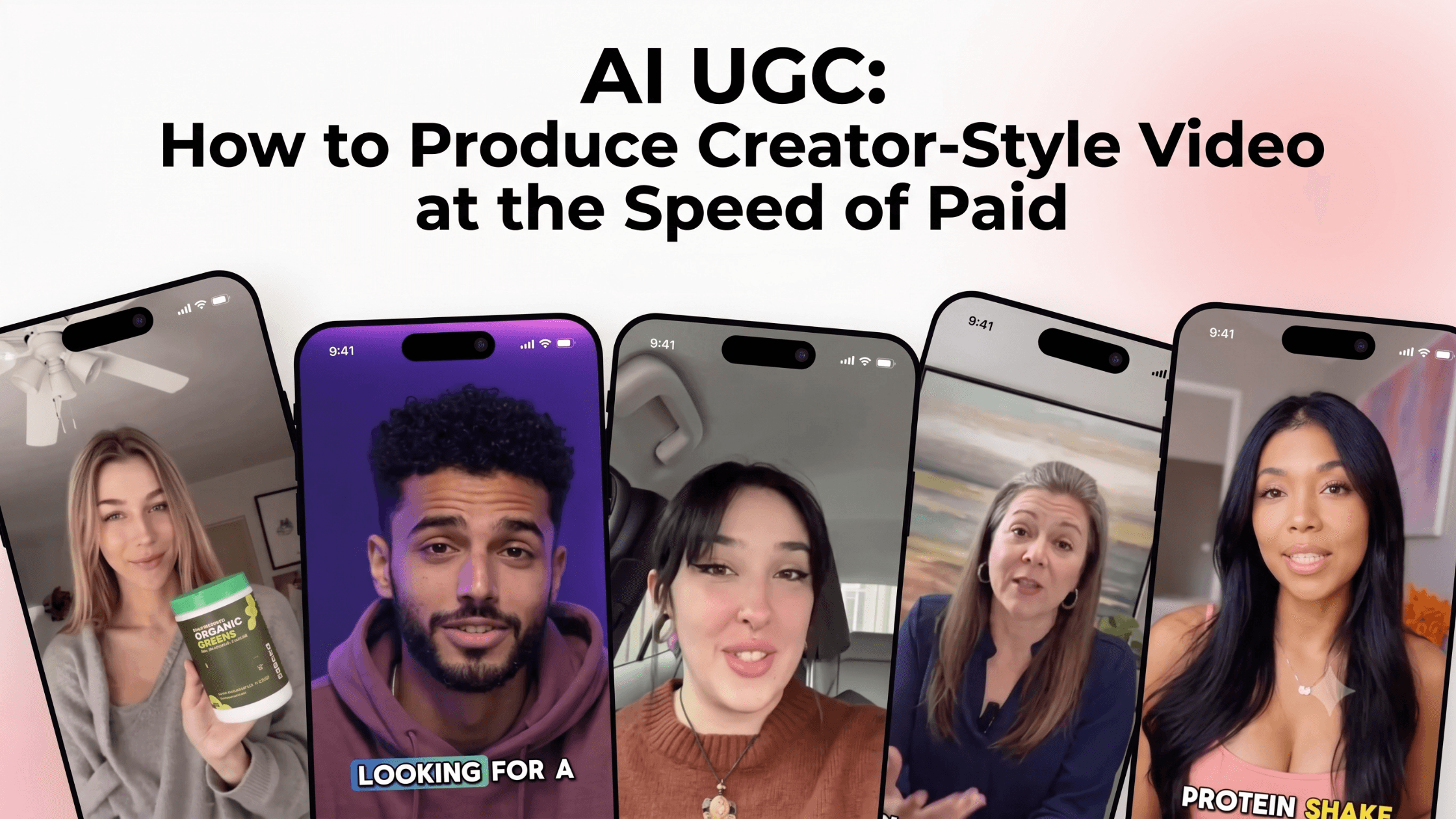
AI UGC is video made to look like real user-generated content (a person talking to camera about a product, an unboxing, a quick product explainer, a get-ready-with-me), except it’s produced with AI rather than filmed with a creator. AI avatars, AI voices, AI-assembled scenes, scripted and generated instead of shot on someone’s phone.
The important words there are “looks like.” Good AI UGC doesn’t look like a glossy brand ad. It looks like the slightly rough, casual, relatable stuff people actually stop scrolling for. That’s the entire point. Polished ads get skipped; content that feels like a real person gets watched. AI UGC is an attempt to manufacture that scroll-stopping feel at scale.
Why it exists: the creative treadmill
To see why AI UGC matters, you have to see why real UGC is such a pain to scale. Getting authentic creator content sounds simple until you actually do it:
– You have to find creators who fit your brand, which takes time and outreach.
– Then brief them, ship them product, and wait for it to arrive and get filmed.
– Then handle the revisions, the reshoots, the back-and-forth.
– And pay per video, which adds up fast when you need a steady stream of them.
Real UGC is genuinely great. It just moves at human speed, and paid advertising moves at algorithm speed. That mismatch is the gap. By the time a batch of creator videos lands, your ad account has already chewed through what you had. AI UGC closes that gap by letting you produce a stack of creator-style variants in the time it used to take to brief a single creator.
Get the fundamentals right before you touch AI
AI doesn’t change what makes UGC convert. A hook that grabs someone in the first couple of seconds. A real problem the viewer actually recognizes. A benefit that genuinely matters to them. A tone that sounds like a person, not a press release. Nail those and the AI is just a faster way to produce it. Skip them and no amount of slick generation will save a video nobody cares about. Write for a human first, generate second.
Make twenty decent videos, not one perfect one
The real advantage of AI here isn’t producing one brilliant video. It’s producing twenty solid ones, fast. Different hooks, different opening lines, different angles, different avatars. Because you can create at volume, you can test at volume, and testing is how you actually find the winners rather than guessing at them.
Treat it exactly like paid creative. Launch a batch, let the data talk, kill the ones that flop, and pour budget into the two or three that take off. The point of speed isn’t to flood the feed. It’s to find your winners quicker and cheaper than a competitor waiting on a creator shoot.
Which formats to generate first
If you’re staring at a blank slate, a few UGC formats reliably pull their weight, and they’re a sensible place to point your first batch.
– **Problem-then-solution.** Someone names a frustration your product fixes, then shows the fix. Simple and it converts, because it mirrors how people actually shop.
– **The unboxing or first impression.** Casual, curiosity-driven, and it works especially well for products that look or feel good in hand.
– **The quick product explainer.** A relatable presenter walking through what the product does and who it’s for, kept short and specific rather than gushing.
– **The three-reasons rundown.** A fast, listy format that’s easy to script and easy to vary for testing.
Start with two or three of these, generate a handful of variants each, and let performance tell you which format your audience responds to. Then double down on the winners rather than spreading yourself thin across every style at once.
Keep it brand-locked
The biggest risk with any AI content is drift. It wanders off-brand, goes generic, or, worse, says something you would never actually claim. When you’re producing at volume, one off-message video can slip out and do real damage.
The fix is to lock it down before you scale it: your voice, your real claims, your look, your list of things you’d never say, all baked into how the videos get made. It also means playing by the rules: label AI-generated content where platforms like Meta and TikTok require it, and never present an AI avatar as a real customer reviewing your product. Speed is only an asset if what you’re pumping out is unmistakably yours.
Respect the uncanny valley
Bad AI UGC feels off. The avatar is a touch too smooth, the voice a little flat, the gestures slightly wrong, and viewers pick up on it even when they can’t put their finger on why. That subtle wrongness erodes trust quicker than a boring video ever would.
Getting through it comes down to a few things: choosing tools that actually clear the quality bar, scripting for natural delivery instead of robotic lines, and, most importantly, keeping a human in the loop to reject the ones that land wrong before they ever go live. AI produces the volume; a person decides what’s good enough to ship.
So does this replace real creators?
No, and be skeptical of anyone who tells you it does. Real creators bring things AI still can’t fake well: genuine authenticity, an actual human face people trust, and a feel for cultural nuance that AI regularly fumbles. AI UGC’s job isn’t to replace that.
Its job is to handle the volume, the speed, and the relentless testing that real creators can’t keep up with at a sane cost. So the smart setup is both. Use real UGC for your hero content and the moments where authenticity is everything. Use AI UGC for the constant stream of testable variants that keep your paid campaigns fed between those hero pieces. Real creators give you depth; AI UGC gives you pace.
Why this matters more now
Two shifts have turned creative into the deciding factor. First, the platforms increasingly reward fresh, native-feeling video and quietly punish stale creative, so the demand for volume has only climbed. Second, as privacy rules shrink how precisely you can target, creative is carrying more of the load than it used to. When you can’t target your way to performance anymore, you have to create your way there.
Put those together and being able to produce good creator-style video, quickly and affordably, stops being a nice extra and becomes a genuine edge. The brands that can feed the machine win. The ones that can’t watch their costs climb as their tired creative burns out.
There’s a quieter benefit too. When making a new video costs you hours instead of weeks, you stop being precious about creative. You can try the weird angle, test the risky hook, and kill it in a day if it flops, with none of the sunk-cost hesitation that comes with an expensive shoot. That freedom to experiment is often where the breakout winners come from.
Where CommerceV3 fits
This is exactly what CommerceV3’s AI UGC is built to do: brand-locked creator video produced at the speed your paid channels actually demand, with the human quality gate that keeps it out of the uncanny valley. And because it runs alongside our paid media under one senior team, the creative and the campaigns it feeds are built in the same loop, so you’re testing and scaling together instead of waiting on a separate video vendor to deliver. We do this for ecommerce brands across verticals, from food and beauty to apparel, pet, and B2B.
Stop starving your ad account of creative
If your paid performance keeps stalling because you can’t make video fast enough, that’s a creative supply problem, not a budget one. Request a free audit from CommerceV3 and we’ll look at how your creative is performing, how quickly it’s fatiguing, and how AI UGC could keep your account fed with fresh, on-brand video. **Request your free audit** to get off the creative treadmill.
Frequently Asked Questions
What is AI UGC?
AI UGC is video made to look like authentic user-generated content, such as a person talking to camera about a product, an unboxing, or a quick product explainer, but produced with AI avatars, voices, and scripts instead of filmed with a real creator. The goal is the casual, relatable feel that makes people stop scrolling, produced fast enough to keep paid campaigns supplied with fresh creative. It’s meant to look like real UGC, not a polished brand ad.
Is AI UGC as good as real creator content?
For different jobs. Real creators bring genuine authenticity, a trusted human face, and cultural nuance that AI still struggles with, which makes them best for hero content. AI UGC wins on volume, speed, and cost, which makes it ideal for the constant testing paid campaigns need. The strongest approach uses both: real UGC where authenticity matters most, and AI UGC for the steady stream of testable variants in between. It’s a complement, not a straight replacement.
Won’t AI UGC look fake?
It can, and that’s the main risk. Poorly made AI video feels subtly off, the avatar too smooth, the voice flat, the gestures slightly wrong, and viewers sense it even if they can’t explain it, which hurts trust. Avoiding that comes down to using genuinely good tools, scripting for natural delivery, and keeping a human reviewer who rejects anything that lands wrong before it goes live. Done carefully, it holds up; done carelessly, it backfires.
How much faster is AI UGC than traditional UGC?
Dramatically, because it skips the slowest parts. Traditional UGC means finding creators, briefing them, shipping product, waiting for filming, and handling revisions, which can take weeks per batch. AI UGC can produce a stack of creator-style variants in the time it used to take to brief a single creator. That speed is the whole reason it exists: paid channels chew through creative faster than human production can supply it, and AI closes that gap.
How do I keep AI UGC on-brand?
Lock your brand into the production before you scale. That means baking in your voice, your real claims, your visual style, and a clear list of things you’d never say, so every video reflects your brand rather than drifting generic. It also means labeling AI content where platforms require it and never presenting an avatar as a real customer. When you produce at volume, one off-message video can slip through and do damage, so brand control matters more, not less.
Where does AI UGC fit in my ad strategy?
As your engine for fresh, testable creative. Paid platforms reward new, native-feeling video and penalize stale creative, so you need a constant supply, which AI UGC provides. Use it to launch many variants, test them like any paid creative, kill the losers, and scale the winners, while keeping real creator content for your hero moments. As targeting gets more restricted by privacy rules, this kind of creative volume is doing more of the work of driving performance.