

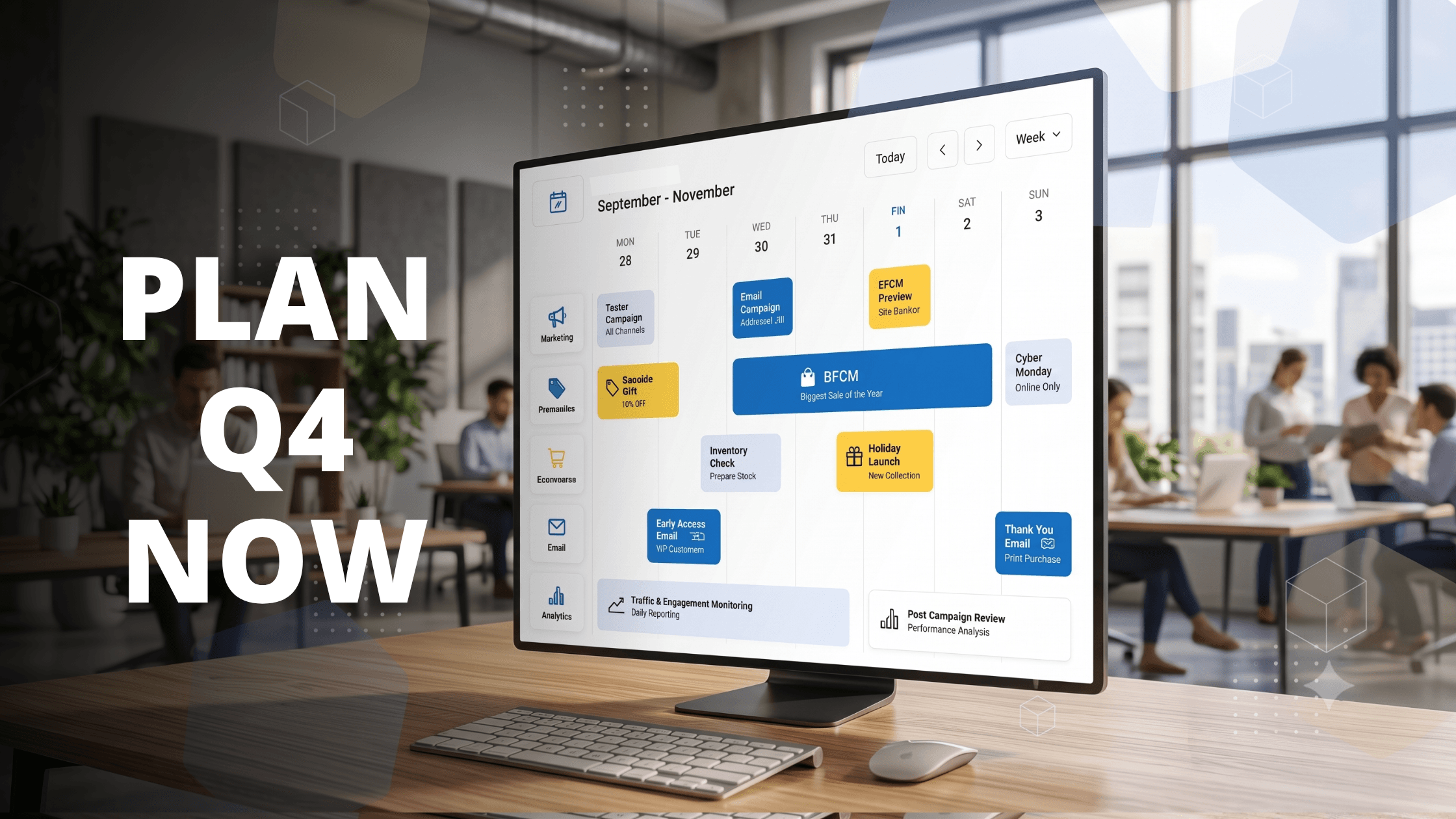
A month-by-month plan for your holiday paid ads, so you arrive at BFCM ready instead of scrambling.
Winning Q4 on paid ads is mostly about doing the right work in the right month. September is for planning and cleanup: set your budget and offers, audit the account, and start building creative. October is for testing and warming: prove your creative, fill your retargeting pools, and get your landing pages ready while clicks are still cheap. November is for execution: ramp into the rush, pace your budget through Black Friday and Cyber Monday, then extend into December rather than stopping. Do each month’s job on time and BFCM becomes a plan you execute, not a fire you fight. Here’s the full calendar.
Is this guide for you? Read on if you run paid ads for an ecommerce brand and you want a clear, month-by-month plan for Q4 rather than a last-minute scramble in November. If BFCM is a minor moment for you, this is more than you need. If it’s a make-or-break window, this calendar keeps you ahead of it.
The brands that win the holiday season rarely have a bigger budget than everyone else. They have better timing. They did the planning while their competitors were still thinking about it, tested their creative while clicks were cheap, and walked into Black Friday with a proven machine instead of a rushed guess. The difference wasn’t spend. It was sequence.
So this is a calendar, not a pep talk. Each month in Q4 has a specific job, and doing that job on time is what separates a smooth, profitable season from a stressful one. Here’s exactly what to focus on in September, October, and November, and why the order matters.
September: plan and clean up
September is your quiet month, and quiet months are precious. Everything you do now is cheaper and lower-stakes than it will be in eight weeks, so this is when you lay the groundwork.
Set your budget, offers, and targets
Decide what you’re actually promoting during BFCM and at what discount, then work out your budget and the return you need to clear given those margins. Going into the season with clear offers and a break-even number keeps you from making expensive decisions in the heat of the moment. Everything downstream depends on knowing these numbers now.
Audit and clean the account
This is the month to fix the waste, while clicks are cheap and mistakes are forgiving. Tighten keywords and match types, build out your negative keyword list, and address any low Quality Scores. A clean account walks into the rush paying closer to the auction floor instead of a self-inflicted premium, and September is the safest time to do that cleanup without risking your peak-season learning.
Start building creative
Creative takes longer than anyone expects, so start now. Brief and produce the images and videos you’ll test in October, across a few different angles and formats. Going into the testing phase with a real library, rather than one rushed ad, is what lets you find winners before the traffic and the stakes rise.
October: test and warm up
October is the most important month, and the one most brands underuse. This is when you turn September’s preparation into proven, ready-to-scale assets, and clicks are still affordable enough to learn cheaply.
Test your creative for real
Put your creative library into the auction and let the data speak. Run your angles and formats against each other so that by early November you know your two or three strongest performers and have backups lined up. Discovering your winners now, on cheap clicks, is far better than paying peak prices to learn the same lesson during BFCM.
Fill your retargeting pools
Run prospecting through October specifically to gather warm audiences, people who viewed products, added to cart, or engaged with your brand. Every one of them becomes someone you can bring back cheaply during the rush. This is quietly one of the highest-return moves of the whole quarter, and it only works if you start filling the pools weeks before you need them.
Get your landing pages ready
The best ad in the world fails if it lands on a slow or confusing page. Use October to speed up your key pages, match their message to your offers, and make buying effortless, especially on mobile. Fixing pages now, before traffic surges, protects both your conversion rate and your ad costs when every click is expensive.
November: execute and extend
November is game time, but if you did September and October properly, it’s execution rather than invention. Your job now is to steer, pace, and then keep going when everyone else stops.
Ramp into the rush
In the first weeks of November, lift your budgets gradually so your campaigns enter Black Friday already scaled and stable, rather than cold. This is also the moment to launch any early-access or teaser offers that capture demand before the crowd arrives. A smooth ramp means the algorithm is trained and your winners are running before the peak.
Pace through Black Friday and Cyber Monday
During the peak, keep budgets high enough that your best campaigns never cap out mid-day, and push spend toward whatever is converting in near real time. Make changes with a light touch, since heavy edits during peak can reset learning at the worst moment. This is the payoff for all the preparation: a proven machine that you steer rather than a guess you scramble to fix.
Extend into December, don’t stop
The most common late-season mistake is switching everything off when Cyber Monday ends. Don’t. Taper your spend gradually and shift your messaging toward last-minute gifting and shipping deadlines. December is full of gift-buyers and everyone who browsed during the rush but didn’t buy, and with competition easing, that demand is cheaper to convert. The brand that keeps going through December captures the profit the brand that stopped left behind.
December: finish the season you paid to set up
The calendar doesn’t end on Cyber Monday, and treating December as an afterthought wastes the audiences and momentum November built. Early December belongs to gift-buyers and the wave of people who browsed during the rush but hesitated, so keep retargeting them and lean your messaging into gifting, gift guides, and shipping deadlines. As the shipping cutoffs approach, urgency does a lot of your selling for you, so make those deadlines loud and clear in your ads. After the cutoffs pass, pivot to gift cards and digital options for the last-minute crowd who missed the post. Handled well, December often carries some of the cheapest, highest-intent traffic of the entire quarter, precisely because so many competitors have already switched off.
The calendar in one line per month
If you take nothing else away, hold on to the single job of each month. September: plan your offers and budget, clean the account, and start creative while it’s cheap to get wrong. October: test that creative for real, fill your retargeting pools, and get your landing pages ready. November: ramp in gradually, pace hard through Black Friday and Cyber Monday, and refuse to switch off when it ends. December: harvest the audiences and momentum you built, and lean into last-minute gifting. Four months, four clear jobs, done in order. That sequence is the whole plan, and it beats a bigger budget spent in a panic almost every time.
Why the sequence matters more than the effort
It’s tempting to think you can compress all of this into November if you just work hard enough. You can’t, and the reason is baked into how paid ads work. Creative needs time to be produced and then tested, and testing needs cheap clicks to be affordable. Retargeting pools need weeks to fill before they’re worth harvesting. Account cleanup is risky to attempt once peak learning is underway. Each month’s job depends on the month before it having been done, which is why a brand that starts in September with a modest budget usually beats one that throws money at November in a panic. The work isn’t harder when it’s early. It’s just cheaper, calmer, and far more likely to pay off.
Where CommerceV3 fits
A Q4 calendar only works if someone actually runs it, month after month, across the ads, the pages, and the follow-up. CommerceV3 handles paid media alongside the landing pages and email under one senior team, so the September cleanup, October testing, and November execution all connect instead of falling between vendors. That’s how a plan on paper becomes a season that’s actually paced well. We do this for specialty and DTC ecommerce brands across food, gift, apparel, beauty, automotive, and B2B.
Get your Q4 plan in place while it’s still September work
The earlier you start, the cheaper and calmer your Q4 gets. Request a free audit from CommerceV3 and we’ll review your account and your pages, then map out what to fix and test in each month so you reach BFCM ready instead of scrambling. Request your free audit and get ahead of the rush.
Frequently Asked Questions
When should I start planning my Q4 paid ads?
September, or earlier if you can. September is for setting budgets and offers, auditing and cleaning the account, and starting creative, all while clicks are cheap and mistakes are low-stakes. Leaving planning until November means learning, testing, and scaling all at once during the most expensive weeks of the year, which is the hardest and priciest way to do it. The earlier you start, the calmer and cheaper the whole quarter becomes.
What’s the most important month for holiday PPC?
October, surprisingly, more than November. October is when you test your creative on affordable clicks, fill your retargeting pools with warm audiences, and get your landing pages ready. Do that well and November becomes execution rather than invention, with proven winners and warm audiences already in place. Brands that treat October as a slow month before the real work end up learning expensive lessons during BFCM itself, when clicks cost the most.
How early should I build my BFCM creative?
Start in September and test in October, because creative always takes longer than expected and you want proven winners before the rush. Going into November with a tested library, knowing your two or three strongest ads plus backups, is far stronger than launching one rushed creative into peak-price traffic. The goal is to discover what works while clicks are cheap, so you’re scaling winners during BFCM rather than gambling on untested ads.
Should I keep spending after Cyber Monday?
Yes. Switching everything off when Cyber Monday ends is one of the most common and costly Q4 mistakes. December is full of gift-buyers, shipping-deadline shoppers, and people who browsed during the rush but didn’t buy, and competition eases, so that demand is cheaper to convert. Taper spend gradually and shift your messaging toward last-minute gifting. The brand that keeps going through December captures profit the brand that stopped simply left behind.
What should I fix on my landing pages before Q4?
Speed, message match, and ease of purchase, especially on mobile. A slow or confusing page wastes the expensive clicks you’ll pay for during BFCM and drags down your Quality Score, so you pay even more per click. Fixing pages in October, before traffic surges, protects both your conversion rate and your ad costs. Make sure each page matches the offer in the ad that points to it, so visitors land exactly where they expected.
Is it too late to plan if I’m reading this in October or November?
No, but move fast and prioritize. If it’s October, compress the plan: audit and clean the account quickly, get your best creative into testing now, and start filling retargeting pools immediately. If it’s November, focus on the highest-leverage moves, cut obvious waste, pace your budget so winners don’t cap out, and commit to extending into December. A partial plan executed well still beats no plan, and the biggest fixes pay off even late.